McDonald’s POS system in US keeps showing up in industry discussions, and for good reason. When speed drops or errors rise, margins feel it fast. Many operators want to know how McDonald’s keeps lines moving and orders clean at scale. In this guide from ConnectPOS, we break down why this POS setup draws attention and what lessons matter for modern US restaurants.
Highlights
- McDonald’s US operations rely on a proprietary POS system built for speed, consistency, and nonstop transaction volume.
- The real strength of McDonald’s POS setup comes from tight integration with workflows, staff training, and store infrastructure.
Why McDonald’s POS System in the US Gets So Much Attention
McDonald’s runs one of the busiest quick-service networks in the country, with 13,557 restaurants in the United States at year-end 2024 (up from 13,457 in 2023). Every day, its US locations handle nonstop orders across counters, drive-thrus, and kiosks. That level of pressure puts the POS setup under constant strain. Yet the system rarely becomes the bottleneck, even as McDonald’s remains the #1 restaurant chain in the U.S. by sales, at about $53.5B across its nationwide footprint.
That reliability is why McDonald’s POS system in US often becomes the reference point for operational discussions, especially at enterprise scale. The company’s own reporting shows the U.S. segment at $10.4B in 2024 revenue, including franchised revenues and company-operated sales, along with $5.7B in operating income.
- A benchmark for quick-service performance: McDonald’s sets expectations for speed and order flow in fast food. When a system works at this scale, others naturally compare their own setups against it. The POS becomes part of the brand’s promise, not just a back-office tool.
- Massive transaction volume across US locations: Thousands of American restaurants process millions of orders daily. The POS handles peak rushes without slowing cashiers or kitchens. That consistency across locations draws attention from operators managing growing order counts.
- Direct link between POS speed and margins: In quick service, seconds matter. Faster checkout means more orders per hour. Fewer errors mean fewer remakes. The POS system quietly supports both, protecting margins during busy periods.
- Strong search interest from operators and teams: Many searches come from owners and managers facing real pressure. They want to understand what powers that scale and whether similar results are possible in their own stores. For growing brands, this curiosity often leads to evaluating POS platforms that can support smoother order fulfillment across front counters and kitchens.
All of this explains the curiosity. The system behind McDonald’s operations represents control under pressure. For restaurants feeling the strain of higher volumes, that level of stability feels worth studying.
What POS System Does McDonald’s Use in the US
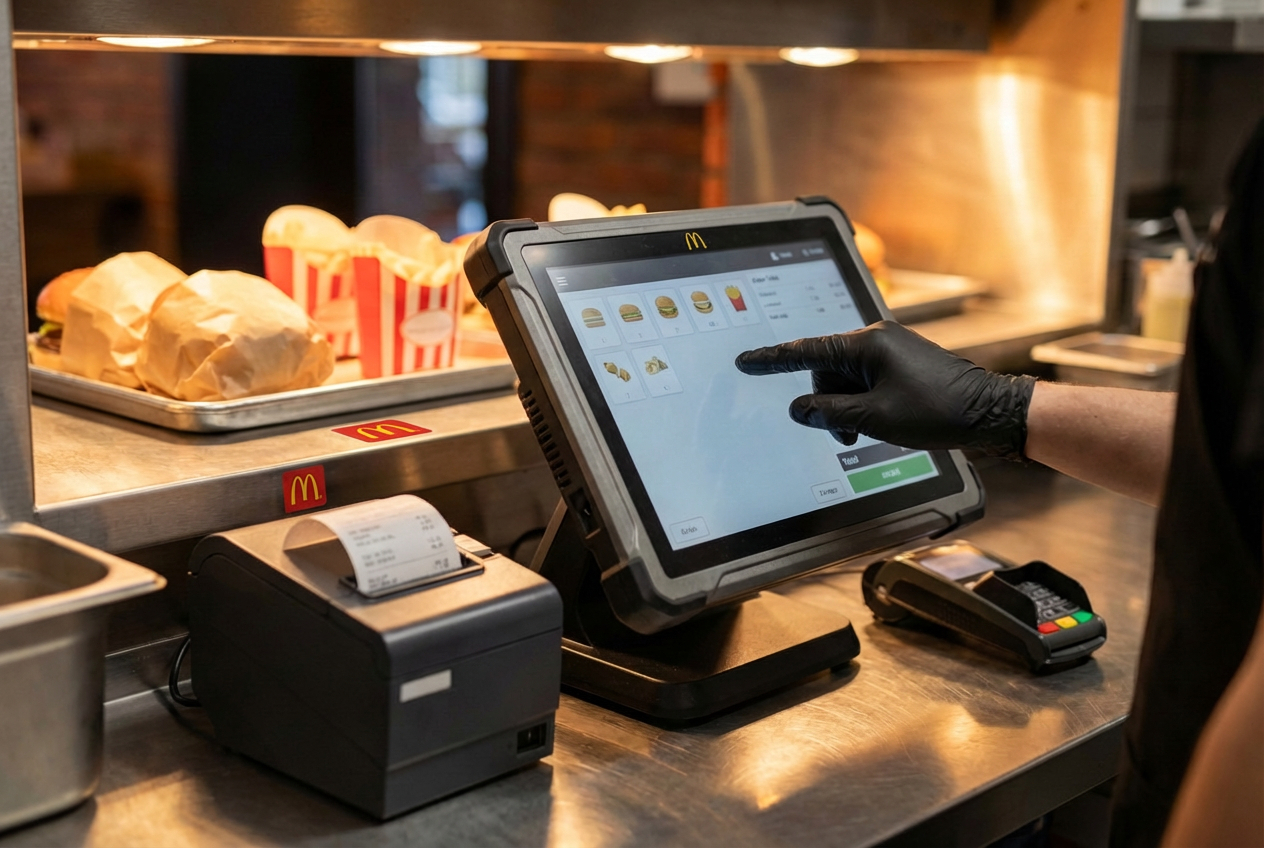
At the center of McDonald’s store operations sits a proprietary platform known as NewPOS NP6. This system powers ordering, payments, and in-store workflows across American locations. McDonald’s POS system in US restaurants was built to handle extreme volume without depending on third-party retail software.
NewPOS began as a product developed by MediaWorks, a Brazilian technology firm focused on large-scale restaurant systems. In the late 2000s, McDonald’s took full control of the platform, including its source code and engineering direction. From that point on, development moved fully in-house. That decision allowed McDonald’s to shape the system around its own operating model.
The NP6 platform is not sold or licensed to other businesses. McDonald’s procures, maintains, and supports the system internally. For restaurant operators researching POS options, this matters. The technology exists to serve one brand, one workflow, and one scale. It was never designed for outside deployment.
From a technical standpoint, the system runs on a customized embedded operating system rather than a typical cloud POS stack. The focus stays on predictability and long service life. Hardware cycles move slowly, and upgrades happen only after long validation periods. That approach helps stores avoid disruption during daily operations.
This long-term mindset explains why the POS setup across US locations looks familiar year after year. The goal is not novelty. The goal is stability under pressure, even when stores run for extended hours and process nonstop orders.
How McDonald’s POS System Is Built for US Quick-Service Demands
Quick-service restaurants face pressure that few retail environments experience. Orders stack up fast, staff rotate often, and downtime costs real money. The McDonald’s POS system in US stores was shaped around these conditions from the start. Its structure reflects daily realities inside American locations, where speed, uptime, and coordination matter more than visual polish or frequent updates.
- High transaction throughput during peak hours: The system processes large volumes of orders without lag, even during lunch and dinner rushes. Cashiers move quickly through menus, payments register instantly, and queues stay under control. That steady flow keeps service moving when demand spikes.
- Hardware stability for long operating days: Many McDonald’s stores run extended hours with little downtime. The POS hardware is built to stay active for long stretches without overheating or crashing. This reliability limits interruptions that could slow service or frustrate staff.
- Tight connection with kitchen and workflows: Orders move directly from the POS to kitchen screens and preparation stations. Timing stays predictable, and staff know what to prepare next without confusion. The system fits into the store’s physical layout and staffing model, rather than forcing changes.
- Consistency across thousands of US locations: Whether you walk into a store in California or Florida, the POS behaves the same way. That consistency supports training, reduces errors, and helps franchise locations maintain uniform service standards.
Together, these elements explain why the POS setup across US restaurants performs under constant strain. It is not built to impress. It is built to endure. For operators managing busy kitchens and front counters, that focus on dependable execution is what keeps operations running smoothly day after day.
How McDonald’s POS System in the US Optimizes Operations
Behind the scenes, the McDonald’s POS system in US restaurants works less like a retail tool and more like an operational control layer. Every design choice points toward one goal. Keep stores moving fast, predictable, and stable, even when pressure builds across hundreds of daily transactions.
Transaction Speed and Order Accuracy
Speed sits at the core of McDonald’s daily operations. The POS setup supports cashiers who may process hundreds of orders in a single shift. Screens respond quickly, inputs register instantly, and checkout never pauses to catch up. That flow helps stores serve more customers without adding front-counter friction.
Menu structure plays a big role here. Items appear in a fixed, familiar order, so staff do not search or hesitate. Button placement stays consistent, and modifiers follow clear logic. Cashiers build orders in seconds, even during peak rush periods.
Accuracy improves as a result. When menus guide input clearly, mistakes drop. Fewer corrections reach the kitchen. Fewer remakes slow the line. During busy lunch hours, that clarity keeps both staff and customers calm.
Franchise variation stays low as well. While store layouts may differ, the POS logic does not. That standard behavior supports uniform service across regions. For operators studying this POS setup, the consistency explains how a massive network delivers the same experience, store after store.
Operational Consistency Across US Locations
Consistency matters as much as speed. McDonald’s runs thousands of locations across the country, many operated by different franchise groups. The POS system behaves the same in each store, which limits variation in daily operations.
Training becomes predictable. New staff learn one interface, one flow, and one set of actions. That familiarity shortens onboarding time and limits confusion during busy shifts. Managers know what to expect from every register.
Franchise variation stays low as well. While store layouts may differ, the POS logic does not. That standard behavior supports uniform service across regions. For operators studying the McDonald’s POS system in US, this consistency explains how a massive network delivers the same experience, store after store.
Deep Integration with Internal Infrastructure
The strength of McDonald’s POS technology comes from how closely it connects with everything around it. The POS does not work in isolation. It sits at the center of a tightly linked environment built for speed and coordination.
Orders flow straight from the register to kitchen display systems. Prep stations see updates in real time, so staff know what to cook next and in what order. That direct link cuts verbal handoffs and limits confusion during busy periods.
Store layouts and staffing models also shape how the POS behaves. Screen flows match counter positions, kitchen zones, and task roles. Cashiers, runners, and kitchen teams all interact with the same order data, but in ways that fit their responsibilities.
This setup depends heavily on internal processes. Training, workflows, and store design all support the system. Software alone does not carry the load. That reliance explains why McDonald’s POS system in US performs best inside its own ecosystem, where every piece moves in sync.
Read more: 5 POS Technology Trends To Look For In 2026
Reliability Over Frequent Hardware Changes
McDonald’s takes a long view on hardware. Rather than chasing frequent upgrades, the company sticks with proven setups that staff already know. Many registers look familiar year after year, and that familiarity matters.
Stable hardware lowers risk. Staff trust the equipment, managers plan around it, and stores avoid disruption. New technology enters slowly, only after testing shows it can handle nonstop use without failure.
There is a clear trade-off here. Innovation moves at a measured pace, but uptime stays high. For McDonald’s, that balance makes sense. When stores run long hours and face constant demand, reliability wins.
You see this mindset across the company’s US restaurant network. The focus stays on keeping registers active, orders flowing, and kitchens fed with accurate data. In quick service, steady performance often matters more than chasing the latest hardware trend.
Why McDonald’s POS System Cannot Be Replicated
It is tempting to look at McDonald’s scale and assume the same POS setup would work anywhere. Many operators search for shortcuts, hoping that matching the technology will deliver similar results. The reality looks different. McDonald’s POS system in US succeeds because of conditions that extend far beyond software.
- Limits of copying proprietary hardware or software: The POS platform used by McDonald’s is built exclusively for its own operations. It is not licensed, sold, or adapted for outside use. Even if similar hardware appeared on the market, the logic behind it would remain inaccessible.
- Dependence on systems, people, and processes: The POS functions inside a tightly controlled environment. Staffing models, training routines, kitchen layouts, and daily workflows all support the technology. Without those pieces in place, the system would lose much of its effectiveness.
- Why NP6 behaves differently outside McDonald’s: NewPOS NP6 was designed to serve one brand at massive scale. It assumes specific order patterns, menu structures, and operational rhythms. Drop it into another restaurant setup, and those assumptions no longer hold.
- Misconceptions about “using the same POS”: Many believe matching McDonald’s technology means matching McDonald’s performance. That belief overlooks the operational discipline behind the screens. Technology supports execution, but it does not replace it.
This is where expectations often fall apart. The system used across US locations works because it operates inside a carefully engineered machine. Trying to recreate it piece by piece misses the bigger picture. For most restaurants, learning from the principles behind the system delivers far more value than chasing an exact copy.
What US Restaurants Can Learn from McDonald’s POS Strategy
Studying McDonald’s operations reveals patterns that go beyond brand size. The real value sits in how decisions get made around systems, workflows, and scale. McDonald’s POS setup reflects a mindset that many restaurants can apply, even without enterprise resources. The lesson is not about copying tools. It is about understanding priorities that hold up under pressure.
- Focus on outcomes, not brand names: McDonald’s does not succeed because of a famous POS label. It succeeds because the system supports fast service, predictable results, and daily stability. Restaurants that chase outcomes tend to build stronger operations than those chasing specific software names.
- Plan for scale from the start: Growth exposes weak systems quickly. McDonald’s built its POS strategy to support thousands of locations rolling out changes at once. For US restaurants planning expansion, rollout speed and consistency matter more than niche features.
- Centralized control supports daily execution: McDonald’s relies on centralized oversight to keep menus, pricing, and workflows aligned. Remote visibility allows issues to surface early. When control stays scattered, small problems often grow before anyone notices.
- Strategy matters more than hardware choices: Registers and screens help, but they do not define performance. McDonald’s treats the POS as part of a broader operating system that includes training, layout, and staffing. Hardware supports the plan, not the other way around.
These lessons apply across restaurant sizes. You may not manage thousands of locations, but the same pressures exist at a smaller scale. Busy hours, staffing changes, and order spikes test systems every day.
This POS setup shows what happens when technology follows a clear strategy. Restaurants that learn from that approach tend to build setups that last, adapt, and perform when it matters most.
Read more: How Zara’s Smart Apparel POS System Drives Success in the Fast Fashion Industry 2026
Choosing a POS System That Fits Modern US Restaurant Operations
After reviewing how McDonald’s runs at scale, one question usually follows. How do you choose a POS system that works in real US restaurant conditions? The answer starts with priorities, not product names. McDonald’s POS system in US succeeds because it supports daily pressure, steady growth, and operational clarity. Those same needs show up in many restaurants, just at a different scale.
- Deployment speed across locations: Rolling out a POS should not stall daily service. Systems that take months to deploy often have slow growth plans. Restaurants expanding to new sites need tools that can go live quickly and behave consistently from day one.
- Remote monitoring and update control: When issues surface, distance should not slow response. Central access allows teams to spot problems early and apply changes without visiting every store. That visibility keeps operations steady, especially across multiple locations.
- Menu and content control at scale: Menus change often. Prices shift. Promotions come and go. A POS must handle updates across stores without confusion. When content stays consistent, staff spend less time fixing mistakes and more time serving customers.
- Security and operating system longevity: Short-term fixes often create long-term risk. Systems built on stable operating environments tend to age better. Restaurants benefit when their POS supports long service cycles without forcing constant reconfiguration.
This is where lessons from McDonald’s become practical. The POS powering McDonald’s US operations works because it matches the realities of restaurant life, not because it chases trends. When choosing your own system, focus on durability, control, and growth readiness. Those choices usually shape results more than any single feature list.
Read more: Chase POS System in the US: A Full Review
ConnectPOS: A Modern POS Built for the Same Scale McDonald’s Requires
McDonald’s success comes from speed, control, and consistency at scale.
ConnectPOS delivers those same outcomes through a modern, cloud-based POS platform that US restaurants can deploy and grow with confidence.
Designed for high-volume environments, ConnectPOS supports fast service, real-time visibility, and centralized control across single-store and multi-location operations.
Key ConnectPOS capabilities aligned with McDonald’s POS principles:
- Real-time omnichannel synchronization: In-store and online sales stay aligned with live inventory, pricing, and order data at all times.
- Centralized inventory and order management: Stock levels, transfers, and order status are managed from one dashboard, reducing manual work and errors, supported by inventory management software that reduces manual work and errors.
- Advanced customer and staff management: Customer profiles, purchase history, and role-based staff permissions support consistent service across locations, with built-in CRM POS capabilities when deeper customer visibility is needed.
- Flexible pricing, discounts, and promotions: Rule-based discounts and promotional logic can be applied uniformly across stores, and teams can layer in loyalty program options to encourage repeat visits.
- Offline mode for uninterrupted operations: Restaurants continue selling during internet disruptions, with automatic data sync once connectivity returns.
- Scalable deployment across locations: New stores can be added quickly without rebuilding workflows or infrastructure, and teams can also tailor rollout needs with custom POS options.
- Hardware-agnostic architecture: Compatible with a wide range of POS devices, helping businesses stay flexible as they grow.
- Secure access control and system stability: Permission-based access and reliable system performance protect data and daily operations.
- Real-time reporting and analytics: Instant visibility into sales, inventory movement, and performance supports smarter decisions.
- Modern service flow options: Restaurants running kiosks or speed lanes can support faster ordering with self-service flows, and streamline prep, pickup, and delivery routing with order fulfillment support.
- Workflow automation at scale: Teams looking to cut repetitive back-office tasks can connect process rules with automation to keep execution consistent across locations.
ConnectPOS enables US restaurants to apply proven operational principles at scale using adaptable, future-ready technology.
It is a practical choice for businesses seeking strong operational control without enterprise-level complexity.
FAQs: McDonald’s POS System in the US
1. What POS system does McDonald’s use in the US?
McDonald’s uses a proprietary platform called NewPOS NP6 across its American locations. This system handles ordering, payments, and store workflows. The McDonald’s POS was built specifically for high-volume quick service, rather than for general retail or third-party use.
2. Is McDonald’s POS system available for other businesses?
No. The POS platform used by McDonald’s is owned, managed, and supported internally. It is not sold or licensed to other restaurants. That exclusivity allows McDonald’s to align the system closely with its own operating model.
3. Does McDonald’s US POS run on cloud or local servers?
The system relies on localized infrastructure rather than a standard cloud POS setup. This approach supports predictable performance and long operating hours. Updates and changes follow controlled internal processes instead of frequent online deployments.
4. How do kiosks connect to McDonald’s POS system?
Self-order kiosks feed orders directly into the same POS environment used at the counter. Orders move straight to kitchen systems without manual entry. That direct connection helps keep timing and order data consistent during busy periods.
5. Can small US restaurants use a similar POS setup?
Most restaurants cannot use the same system, but they can follow similar principles. McDonald’s POS setup shows how stability, scale readiness, and centralized control support daily operations, regardless of restaurant size.
Final Thoughts
McDonald’s POS system in US proves one thing clearly. Strong operations come from clarity, consistency, and systems built for real pressure. While the technology itself remains proprietary, the principles behind it apply widely. Restaurants that understand these principles often gain better control during peak hours and avoid operational chaos as order volume rises. If you want a POS platform that supports growth, control, and steady performance, ConnectPOS helps you move in that direction. It gives you the tools to manage daily operations without adding complexity. Contact us now to see how ConnectPOS fits your restaurant’s next stage.
►►► Optimal solution set for businesses: Shopify POS, Magento POS, BigCommerce POS, WooCommerce POS, NetSuite POS, E-Commerce POS