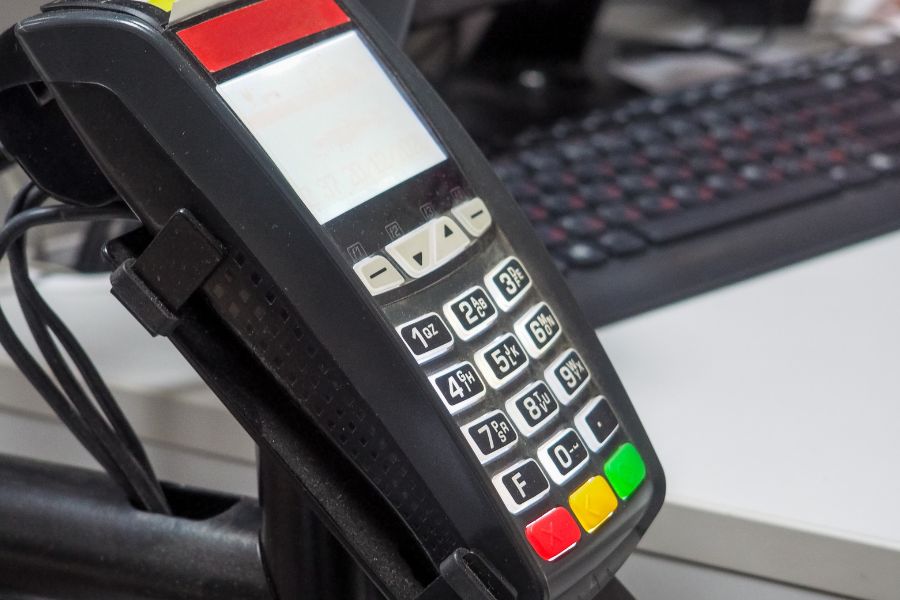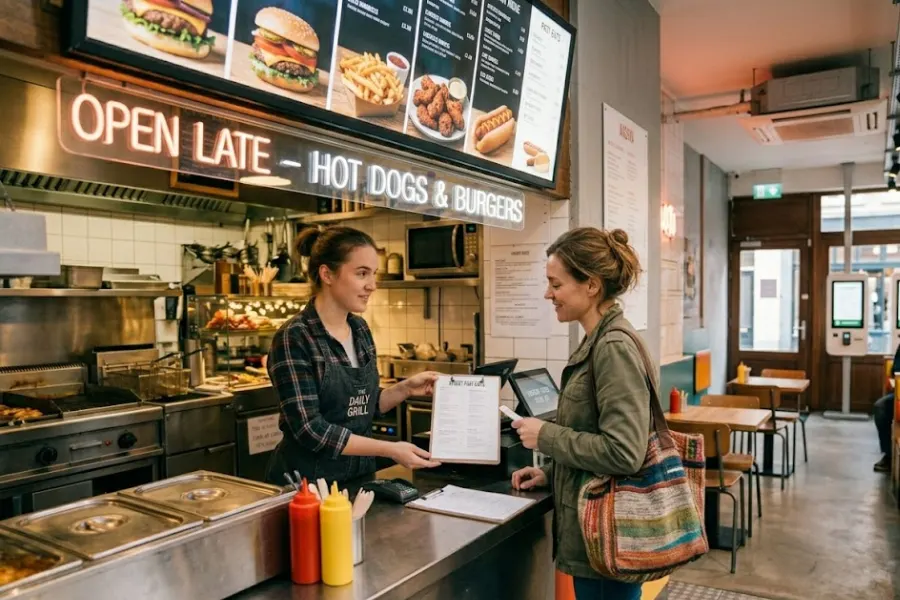
Quick service restaurants compete in an environment where speed, accuracy, and consistency directly influence customer perception and long-term positioning. Technology decisions shape how orders flow, how teams respond during peak hours, and how data is translated into actionable insight. The best quick service restaurant POS no longer serves as a simple transaction tool; it defines operational discipline and sets the foundation for scaling across channels and locations.
Sustained growth requires more than just processing transactions; it requires coordination across ordering channels, kitchen execution, and customer engagement, from first interaction to repeat purchase. This article from ConnectPOS provides a focused perspective on the POS features that support that level of control and differentiation.
Highlights
- Competitive advantage requires more than just transaction processing; it requires alignment across ordering, kitchen execution, and customer data, where a strong POS shapes speed, accuracy, and consistency.
- Quick service restaurant growth needs a POS with connected capabilities across ordering, payments, kitchen flow, reporting, and customer engagement to support daily performance and expansion.
Benefits of the Best Quick Service Restaurant POS for Competitive Advantage
The global Quick Service Restaurant (QSR) market size is expected to reach 24,000 million by 2032, growing at a CAGR of 7,4%. This expansion brings higher-order volume and stronger competition, placing greater pressure on operational consistency.
The best quick service restaurant POS acts as a control layer that connects transactions, kitchen flow, and customer data into one coordinated system. Restaurants using fragmented tools face inconsistency during peak periods, while those with a structured POS maintain control over speed, accuracy, and customer engagement, supporting stronger brand perception and repeat business as the market grows.
Key Benefits
- Faster order throughput under pressure: Order routing aligns front counter, self-service, and kitchen display systems; ticket flow remains stable during peak hours, and staff interaction becomes more predictable even as volume increases.
- Improved order accuracy and consistency: Menu logic enforces modifiers and combinations; fewer manual corrections appear, and kitchen teams receive clearer instructions that match customer expectations.
- Real-time visibility into operations: Sales data updates continuously across locations; managers track performance as it happens, and immediate adjustments can be made when demand patterns shift.
- Tighter control over inventory and cost: Ingredient-level tracking connects each sale to stock consumption; purchasing decisions become grounded in actual usage patterns rather than estimates.
- Stronger customer retention and personalization: Customer profiles capture ordering habits and preferences; targeted promotions become more relevant, and repeat visits increase as experiences feel more tailored.
- Better staff coordination and productivity: Task allocation aligns with order flow; front-of-house and kitchen teams operate with shared visibility, which limits confusion during high-volume service.
- Scalability across locations: Centralized configuration keeps menus, pricing, and promotions consistent; new locations adopt existing workflows without lengthy setup or retraining cycles.
- Data-driven decision making: Reporting surfaces product performance, peak periods, and staff output; leadership teams gain a clearer basis for pricing, staffing, and expansion strategies.
- Consistent omnichannel experience: Online orders, in-store transactions, and third-party integrations connect within the same system; customers encounter the same menu logic and service standards regardless of ordering channel.
- Higher resilience during peak demand: System stability supports continuous transaction processing; downtime risk decreases, and revenue opportunities during rush periods are protected.
Critical POS Features for Successful Quick Service Restaurants
The Quick Service Restaurant (QSR) POS system market is growing at 9.7% and is projected to reach 23.5 billion by 2033, reflecting rising demand for more structured and scalable operations.
A restaurant runs on precision, timing, and consistency across every touchpoint, with the quick service restaurant POS at the center of how orders are captured, transmitted, and fulfilled. When digital channels, kitchen execution, and customer data are aligned, operations remain consistent, and growth becomes more sustainable, while gaps in capability often lead to bottlenecks and miscommunication during peak demand.
Key Features
- Online Ordering and Delivery Integration: Digital ordering connects directly with in-store operations; order queues remain synchronized, and third-party platforms feed into the same workflow without manual re-entry.
- Secure and Flexible Payment Processing: Payment methods adapt to customer preferences; transactions complete across cards, mobile wallets, and contactless options while maintaining strict data protection standards.
- Kitchen Display System (KDS): Order tickets appear in real time on kitchen screens; preparation sequences stay organized, and communication between front-of-house and kitchen teams becomes more structured.
- Menu Management: Menu configurations reflect pricing, modifiers, and availability; updates apply across all channels, and inconsistencies between in-store and online menus are minimized.
- Reporting and Analytics: Sales data aggregates across time periods and locations; performance patterns become visible, and decision-making shifts toward measurable outcomes rather than assumptions.
- Customer Engagement Tools: Customer profiles store purchase history and preferences; targeted promotions align with behavior patterns, and loyalty strategies gain stronger traction over time.
- Cloud-Based Management: System access extends beyond a single location; operators monitor performance remotely, and updates deploy across the network without on-site intervention.
A POS built with these capabilities supports operational clarity and consistency. It shapes how teams execute during high-volume service and how leadership evaluates performance across locations, forming a direct link between daily operations and long-term business positioning.
How ConnectPOS Empowers Quick Service Restaurants to Grow
ConnectPOS supports quick service restaurants through a system that connects ordering, kitchen execution, inventory control, and customer engagement into one coordinated operational flow.
Growth in this segment requires more than just handling transactions; it requires alignment across front-of-house activity, kitchen performance, and backend data, from order capture to fulfillment and repeat purchase. When these elements operate in sync, restaurants maintain consistency during peak demand while building a foundation for expansion across locations and channels.
Key Features Driving Growth:
- Raw-Material Inventory: Tracks ingredients at a granular level and links each order to stock consumption; purchasing decisions reflect actual usage patterns, and stock shortages or over-ordering become easier to control
- Real-Time Analytics: Captures sales, product performance, and peak-hour activity as transactions occur; managers gain immediate visibility into operations and can adjust pricing, staffing, or promotions based on current data
- Digital Kitchen Displays: Sends orders directly to kitchen screens in real time; preparation queues stay organized, and communication between front-of-house and kitchen teams becomes more consistent during high-volume service
- Smart Combo Prompts: Recommends item combinations during order entry based on predefined logic; staff increase average order value while maintaining a smooth and guided ordering process
- Scalable multi-location management: Menus, pricing, and promotions remain consistent across branches; new outlets adopt existing configurations, and operational standards stay intact during expansion with support from ConnectPOS multi-store management capabilities.
- Self-Service and QR Ordering: Introduces additional ordering touchpoints through kiosks and QR-based menus; customers place orders independently, and restaurants handle higher volume without increasing pressure on staff
- Customer engagement and retention support: Customer insights accumulate through each transaction; campaigns align more closely with real behavior, and return visits grow stronger through personalized engagement powered by ConnectPOS customer loyalty and CRM tools.
ConnectPOS brings these capabilities together within a single platform, allowing quick service restaurants to maintain control over daily execution while scaling operations. As order volume grows and customer expectations evolve, the system supports consistent performance and positions restaurants for sustained expansion.
FAQs: Best Quick Service Restaurant POS
1. What POS features directly impact service speed?
Order routing determines how quickly tickets reach the kitchen; kitchen display systems organize preparation flow, and integrated ordering channels prevent duplication during peak periods.
2. How does the best quick service restaurant POS improve order accuracy?
Menu logic structures, modifiers, and combinations; staff follow guided input steps, and kitchen teams receive clear, standardized instructions for every order.
3. Why does online ordering integration matter for growth?
Digital channels connect with in-store operations; order volume expands beyond physical queues, and restaurants capture demand from customers who prefer remote ordering.
4. What role does reporting play in competitive positioning?
Sales data reveals product performance and peak hours; management teams adjust pricing, promotions, and staffing based on measurable trends rather than assumptions.
5. How can the best quick service restaurant POS support multi-location expansion?
Centralized control keeps menus and pricing aligned; new outlets adopt existing workflows, and brand consistency remains intact across locations.
What should restaurants expect from payment processing capabilities?
Flexible payment acceptance covers cards, mobile wallets, and contactless options; transactions complete quickly, and customer checkout experiences remain smooth during busy periods.
Conclusion
The best quick service restaurant POS shapes how a quick service restaurant performs under pressure and how it evolves over time. Each feature, from order integration to reporting and customer engagement, contributes to a broader operating model where consistency and adaptability define competitive positioning. Restaurants that align these capabilities gain stronger control over daily execution and build a foundation for sustainable expansion.
To explore how these capabilities translate into real operational impact, connect with ConnectPOS and discover how the system supports growth across every stage of your quick service business.
►►► Optimal solution set for businesses: Shopify POS, Magento POS, BigCommerce POS, WooCommerce POS, NetSuite POS, E-Commerce POS