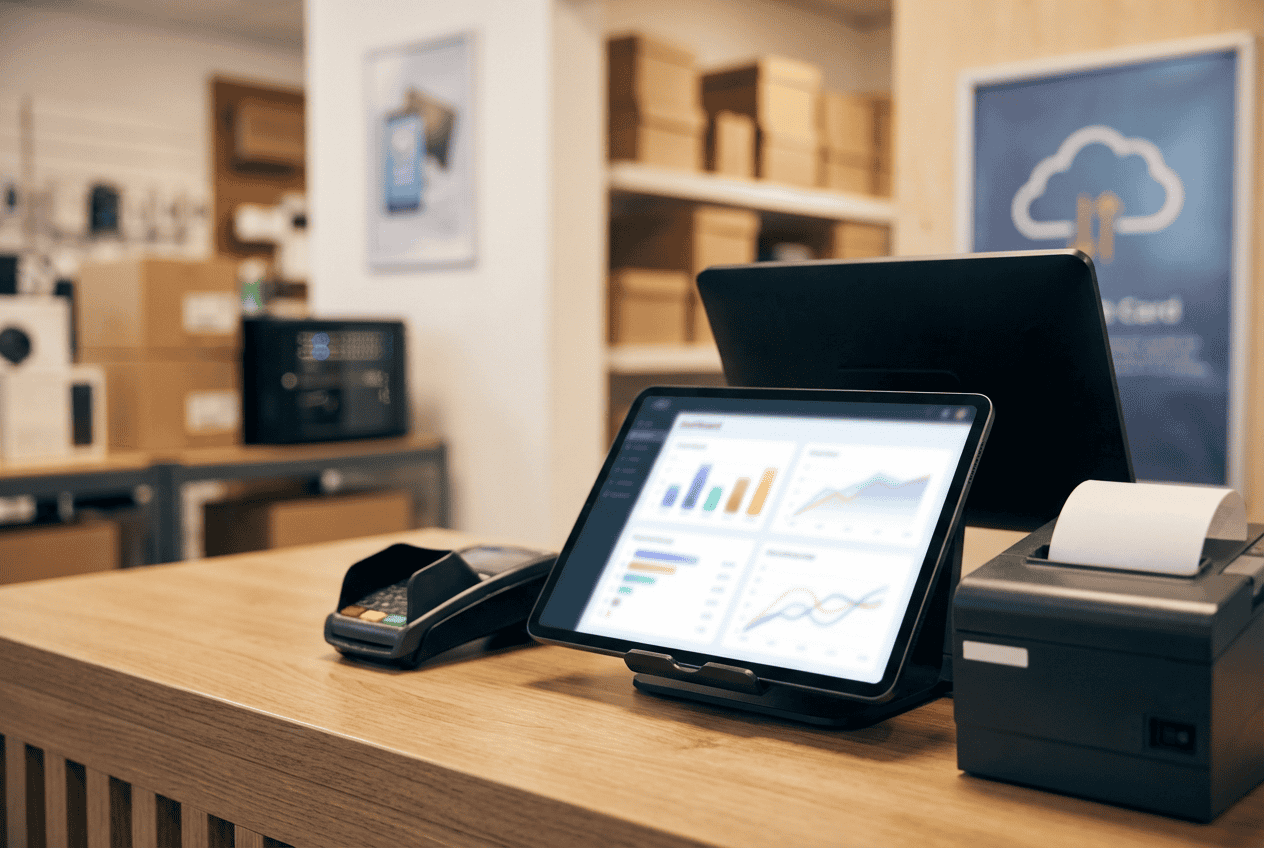
The US retail landscape keeps raising the bar. Shoppers expect seamless experiences across online and in-store channels, staff shortages push teams to do more with less, and data plays a bigger role in everyday decisions. In this environment, basic POS system software in the US can no longer support long-term growth. Simple transaction processing may keep stores running, but it does little to improve efficiency, customer loyalty, or scalability. That’s why more retailers are moving toward POS system software with advanced features.
Let’s learn about these modern capabilities that go beyond daily operations, helping businesses adapt faster, connect channels, and build a foundation for sustainable growth in a competitive US market!
Highlights
- Cloud-based architecture, real-time data sync, unified commerce, automation, and multi-location inventory management are advanced features for business growth in the US market.
What Defines a Modern POS System Software in US Market?
A modern POS system in the US looks very different from traditional, legacy setups. Older POS software was often installed on local servers, required manual updates, and worked in silos. These systems handled basic transactions well, but adapting them to new sales channels, locations, or customer expectations was slow and costly.
In contrast, modern cloud-based POS software is built for flexibility. It updates automatically, supports real-time data sync, and works reliably across stores, warehouses, and online channels.
Scalability is a key requirement for US retailers, especially those planning to expand across states or manage high transaction volumes. Modern POS systems are designed to grow without major system changes.
Compliance is another critical factor, covering sales tax rules, payment security standards, and data protection. Strong ecosystem integrations also matter, allowing the POS to connect smoothly with eCommerce platforms, ERP systems, payment providers, and third-party apps.
Today, the POS serves as a central commerce POS platform. It unifies inventory, customer data, orders, and fulfillment, helping retailers run their entire operation from one connected system rather than a simple checkout counter.
Advanced POS Features That Support Long-term Business Growth
Modern POS systems bring together data, automation, and integrations to support smarter decisions and smoother daily operations.
Cloud-based Architecture and Real-time Data Sync
Cloud-based POS systems create a single source of truth for retail operations. All data is stored and updated centrally, making it accessible across locations and devices.
- Centralized sales, inventory, and customer data shared across stores, warehouses, and online channels
- Real-time insights into revenue performance, stock levels, and customer behavior
- Faster decision-making based on live data rather than delayed reports
- Offline selling capabilities that keep stores running during connectivity issues, with automatic data synchronization once the network is restored
This setup helps retailers avoid data gaps, reduce delays, and respond faster to demand changes.
Omnichannel Sales and Unified Commerce
Omnichannel capability is essential for long-term growth in the US market. Modern POS systems are designed to manage all sales channels from one platform.
- A single POS system for in-store, online, mobile, curbside, and BOPIS transactions
- Unified carts, orders, payments, and customer profiles across channels
- Flexible fulfillment options such as ship-from-store, click-and-collect, and split orders
- Seamless integrations with leading eCommerce platforms like Shopify, Magento, BigCommerce, WooCommerce, and others
This unified commerce approach removes data silos and delivers a consistent customer experience at every touchpoint.
Advanced Inventory and Multi-location Management
As retailers grow, inventory becomes more complex. Advanced POS systems are built to handle this complexity at scale.
- Multi-source inventory management across stores, warehouses, and third-party logistics providers
- Real-time stock visibility to prevent overselling and improve replenishment accuracy
- Support for high-SKU volumes, variants, bundles, and complex product catalogs
- Demand forecasting tools that help retailers plan purchasing and reduce excess stock
These capabilities improve cash flow, reduce operational risk, and support expansion into new locations.
Automation and Workflow Customization
Automation is a key driver of efficiency and consistency. A modern POS software in USA allows retailers to reduce manual processes through configurable rules and integrations.
- Automated pricing, promotions, discounts, and tax rules
- Inventory alerts, reorder triggers, and transfer workflows
- API-first and headless architecture for building custom processes and integrations
- Flexible workflows that adapt to different store formats, regions, or business models
Automation reduces human error and frees up staff time for higher-value activities.
Customer Data, Loyalty, and Personalization
Long-term growth depends on repeat customers and strong engagement. Advanced POS systems help retailers build deeper relationships through connected customer data.
- Centralized customer profiles shared across online and offline channels
- Purchase history, preferences, and engagement data are available in real time
- Loyalty programs, targeted promotions, and personalized offers
- Support for consumer apps, digital receipts, and personalized communication
By using POS-driven customer insights, retailers can improve retention, increase lifetime value, and create more relevant shopping experiences over time.
Security, Compliance, and Reliability for US Businesses
For US retailers, a POS system must do more than support sales and growth. It also needs to meet strict security standards, follow complex regulations, and remain reliable under daily operational pressure. Modern POS system software in US is built with these requirements in mind, helping businesses reduce risk and maintain customer trust as they scale.
Key areas include:
- PCI-DSS compliance and secure payments: Advanced POS systems follow PCI-DSS standards to protect cardholder data. Features such as tokenization, encryption, and secure payment gateways help reduce fraud risks and safeguard customer information.
- Tax management and regulatory support: US sales tax rules vary by state, county, and city. Modern POS systems support automated tax calculations, accurate reporting, and integration with tax engines to handle changing regulations more efficiently.
- System reliability and uptime: Cloud-based infrastructure is designed for high availability, ensuring the POS remains accessible during peak hours. Offline mode allows stores to continue selling during connectivity issues.
- Disaster recovery and data protection: Regular data backups, redundancy, and recovery protocols help protect business data and minimize downtime in unexpected events.
Why ConnectPOS Is a Suitable POS System Software in the US
Selecting a POS system is a long-term commitment for US retailers, especially those planning to grow across locations, channels, and fulfillment models. ConnectPOS is designed as a unified commerce ecosystem rather than a basic transaction tool. Its modern, cloud-native architecture gives retailers a stable core that can scale and adapt as business needs evolve.
- Truly unified commerce: ConnectPOS centralizes in-store sales, eCommerce, inventory, and customer data in one real-time platform. This eliminates data silos and manual syncing common with loosely connected POS and add-on tools.
- Innovation without system disruption: Built with an API-first, headless design, ConnectPOS allows retailers to introduce new channels, integrations, and custom workflows without modifying or replacing the core POS system.
- Enterprise-grade scalability: The platform supports multi-store, franchise, and multi-entity operations with centralized control, role-based permissions, and flexible organizational structures.
- High performance at scale: Real-time synchronization, offline continuity, and cloud infrastructure ensure reliable operations during peak traffic, seasonal spikes, and high transaction volumes.
- Future-ready flexibility: ConnectPOS enables fast adaptation to new sales channels, fulfillment options, and customer engagement models as US retail trends and consumer expectations shift.
Moreover, a modular, all-in-one ecosystem reduces dependence on third-party systems. Retailers avoid repeated replatforming, complex middleware, and rising integration costs as they scale. Together, these advanced capabilities position ConnectPOS as a strategic POS investment for retailers focused on sustainable, long-term growth rather than short-term operational fixes.
In Conclusion
Advanced POS system software in US has become a growth driver for US retailers, not just a tool for processing transactions. With cloud-based architecture, unified commerce, real-time data, and built-in scalability, modern POS platforms help businesses adapt faster, operate more efficiently, and deliver better customer experiences over time.
As competition increases and retail models continue to evolve, investing in the right POS system can define long-term success. ConnectPOS is designed to support that journey with a flexible, API-first commerce ecosystem built for scale, reliability, and innovation.
Contact us today to explore how ConnectPOS can help future-proof your retail operations and turn your POS into a strategic engine for sustainable growth.
FAQs
How does a POS system support long-term business growth rather than short-term operations?
A modern POS system software in US supports long-term growth by centralizing sales, inventory, and customer data. It enables better decision-making, easier expansion, and consistent operations across locations and channels, rather than focusing solely on daily transactions and basic checkout functions.
Why are cloud-based POS systems becoming the standard in the US retail market?
Cloud-based POS systems offer scalability, automatic updates, real-time data access, and lower infrastructure costs. They also support remote management, multi-location operations, and better system reliability, which are essential for US retailers operating across states and sales channels.
How important is omnichannel capability for US retailers planning to scale?
Omnichannel capability is critical for scaling because customers expect seamless experiences across online and in-store touchpoints. A unified POS system helps retailers manage orders, inventory, and customer data consistently, reducing friction and supporting growth across multiple sales channels.
What role does inventory management play in POS-driven growth strategies?
Inventory management ensures the right products are available at the right locations. Advanced POS systems provide real-time stock visibility, multi-location control, and demand forecasting, helping retailers reduce stockouts, prevent overstocking, and improve cash flow as they grow.
►►► Optimal solution set for businesses: Shopify POS, Magento POS, BigCommerce POS, WooCommerce POS, NetSuite POS, E-Commerce POS