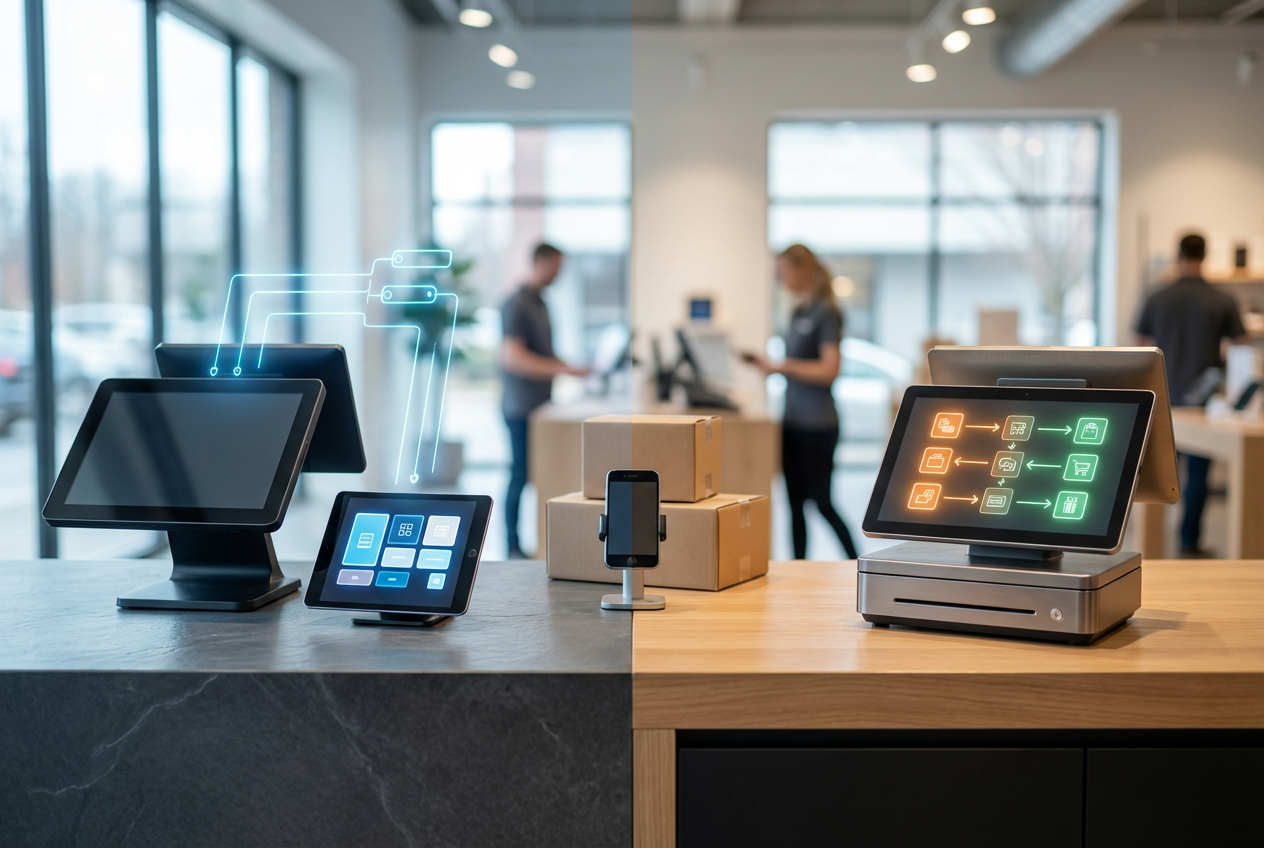
Retailers comparing ConnectPOS vs Shopify POS often start from the same question: which system aligns more closely with the way their stores actually operate? Both platforms approach retail from different angles, one built around high customization and cross-platform flexibility, the other tied closely to a native commerce ecosystem. The contrasts matter for merchants dealing with varied catalogs, mixed online–offline workflows, or store networks that need consistent control.
This article from ConnectPOS encourages retailers to look beyond surface-level functions and focus instead on how each system supports day-to-day realities and long-term plans.
Highlights:
- ConnectPOS gives retailers wide room to shape their POS around varied catalogs, complex store setups, and cross-platform operations, making it suitable for businesses that want strong control over how their online and offline environments work together.
- Shopify POS fits merchants who build their sales model around the Shopify ecosystem, focusing on tight connection with Shopify’s online storefront, simple deployment, and unified management inside one commerce platform.
Overview of Each POS System – ConnectPOS vs Shopify POS
ConnectPOS and Shopify POS represent two distinct product development philosophies, and the choice depends heavily on where your business places its development focus.
ConnectPOS: The Agnostic Omnichannel Solution for Scalable Retail
ConnectPOS is positioned as an omnichannel-first, agnostic POS solution. It was engineered to function as a powerful, standalone retail management system capable of deep integration and real-time synchronization with multiple leading e-commerce platforms (such as Shopify, Magento, BigCommerce).
ConnectPOS targets medium to large-scale businesses, especially those that need complex multi-warehouse management, require next-generation customer interaction features (like AI facial recognition, self-checkout), and desire flexibility in choosing payment gateways (avoiding being locked into a single processor to manage transaction fees). It serves retailers who demand a robust POS system independent of a single e-commerce platform.
Shopify POS: The Natural Extension of the Shopify Ecosystem
Shopify POS, conversely, is clearly positioned as the native, integrated extension of the Shopify ecosystem. It is designed to work smoothly with the Shopify backend, effectively turning your online store into a physical one. This is the most reliable, built-in solution for anyone who already uses Shopify as their core e-commerce platform.
Shopify POS (particularly the Pro version) is ideal for businesses, from small to large, that want to capitalize on simplicity, an intuitive interface, and instant synchronization (inventory, customer data) without relying on third parties. Its main value is convenience and unity; the system is especially powerful when the seller uses Shopify Payments, making financial management as straightforward as possible. However, it is largely proprietary, not integrating with other e-commerce platforms outside of Shopify.
Core Feature Comparison – ConnectPOS vs Shopify POS
The core feature comparison reveals a divergence in product philosophy, where ConnectPOS focuses on omnichannel flexibility and external integration with various e-commerce platforms. Conversely, Shopify POS prioritizes absolute unity and instant synchronization within the Shopify ecosystem while providing a highly user-friendly experience optimized for iOS devices.
E-commerce Integration and Omnichannel Focus
ConnectPOS bases its design on omnichannel flexibility. Its core technical strength lies in its API-first approach, allowing it to establish deep, real-time connections with external e-commerce POS platforms (Magento, BigCommerce, Shopify). This makes ConnectPOS appropriate for retailers who operate on a fragmented commerce architecture or plan to switch e-commerce platforms.
Shopify POS achieves instant, inherent synchronization because the POS system and the e-commerce store share the same backend database (the Shopify admin). This singular, unified environment guarantees inventory updates, customer data, and order history are always consistent. This provides reliability within the Shopify ecosystem, but the system lacks the flexibility to integrate with external e-commerce systems.
Inventory Management
Shopify POS handles basic inventory tracking, handling standard variations (size, color) and managing stock across several retail locations. For highly specialized functions like complex vendor management or stock matrix handling, the user needs to rely on third-party apps from the Shopify App Store, which adds complexity and cost.
ConnectPOS excels at complex inventory scenarios involving several physical warehouses and detailed attribute tracking. The system provides tools for multi-warehouse management, purchase order creation, and stock transfer between locations. Its synchronization is engineered to handle large, complex catalogs across various digital storefronts.
Sales Processing and Hardware Compatibility
Shopify POS provides a user-friendly interface that works flawlessly on iOS devices (iPads). The system is designed for speed and uses a straightforward checkout process. It encourages the use of Shopify’s branded hardware (card readers, receipt printers), which delivers a smooth plug-and-play experience.
ConnectPOS shows strong hardware agnosticism, meaning it works with a wider range of third-party hardware peripherals, including different brands of receipt printers and scanners, helping retailers reuse existing equipment. Its interface is web-based, operating across various operating systems (iOS, Android, PC), prioritizing flexibility in hardware choice.
Reporting and Analytics
Shopify POS reports are deeply integrated with the overall Shopify analytics platform, providing unified views of sales, customer behavior, and marketing performance across all online and offline channels. The reporting is strong for analyzing growth metrics related to the core Shopify platform.
ConnectPOS focuses its reporting on omnichannel performance. Its analytics help managers compare sales volume, inventory movement, and revenue generated across different online channels versus physical stores. This capability serves businesses needing to evaluate the performance and profitability of their unified digital and physical sales strategy.
Pricing Comparison – ConnectPOS vs Shopify POS
Analyzing the cost structure of ConnectPOS vs Shopify POS reveals two distinct pricing philosophies: ConnectPOS charges based on the scale and complexity of omnichannel integration, while Shopify POS layers its pricing primarily around the level of integrated features and the payment processing platform used. Understanding these models is key to determining which system provides greater long-term value for your specific retail operation.
ConnectPOS Pricing
ConnectPOS typically uses a tiered subscription model with a recurring monthly fee (specific, fixed pricing usually requires direct contact, but this is the common structure):
- Pricing Structure: Pricing is tiered based on the number of physical retail locations, the number of required registers, and most importantly, the type and number of e-commerce integrations needed.
- Plan: Plans might start around $39 – $49/month for basic single-store setups and increase significantly for Enterprise plans requiring deep API integration with large platforms (Magento, BigCommerce).
- Initial Costs: May include setup or integration fees, especially when connecting to large-scale or heavily customized e-commerce systems.
- Payment Advantage: ConnectPOS is payment processor-agnostic, allowing retailers to choose the third-party provider with the lowest processing fees (negotiated third-party rates), which helps control transaction costs effectively.
Shopify POS Pricing
Shopify POS pricing is calculated in layers, tied directly to the retailer’s overall Shopify e-commerce plan:
Base E-commerce Fee (Required):
- Shopify Basic: Approximately $29/month (External transaction fees apply).
- Shopify: Approximately $79/month.
- Shopify Advanced: Approximately $299/month.
POS Add-on Fee (Optional):
- Shopify POS Lite: $0 (Included with all Shopify plans).
- Shopify POS Pro: Approximately $89/month per location (added to the base plan fee). The Pro plan unlocks advanced features (e.g., staff management, in-store pickup).
Transaction Processing Fees:
- Using Shopify Payments: Lowest fees apply (e.g., 2.4% + $0 for in-person card transactions with the Advanced plan).
- Using a Third-Party Gateway: Shopify charges an additional transaction fee (around 0.5% – 2.0%) on the total sale, which drives the overall cost up.
Read more: Shopify POS Lite vs Pro: Features, Pricing, and Key Differences 2026
Which is More Cost-Effective?
Determining the more cost-effective solution is entirely dependent on the retailer’s existing setup and business goals:
- Shopify POS is generally more cost-effective for: Retailers who already use Shopify as their core e-commerce platform and are willing to use Shopify Payments. The unified billing and reduced transaction fees within the ecosystem make the total cost predictable and generally lower for optimized, unified operations.
- ConnectPOS is generally more cost-effective for: Retailers who use multiple, external e-commerce platforms or who have high sales volume and can negotiate lower third-party credit card processing rates. The money saved on transaction fees often offsets the ConnectPOS subscription cost.
Pros and Cons – ConnectPOS vs Shopify POS
The analysis of Pros and Cons clearly reveals the two strategic paths taken by ConnectPOS vs Shopify POS. This section highlights the core benefits each system delivers, ranging from ConnectPOS’s multi-platform flexibility to Shopify’s absolute unity within its ecosystem. It also points out the associated risks and limitations regarding cost, dependency on third parties, or integration inflexibility, helping businesses accurately assess the cost and benefit of each solution.
ConnectPOS Pros And Cons
Pros
- Deep Integration: Strong integration with external e-commerce platforms (Magento, BigCommerce).
- Real-time Sync: Performs real-time inventory synchronization between physical stores and online channels.
- Payment Flexibility: Payment processor-agnostic, allowing selection of the lowest transaction fees.
- Scalability: Good scalability for multi-platform and multi-location businesses.
Cons
- Learning Curve: May have a steeper learning curve for new staff due to integration complexity.
- Initial Cost: Initial setup cost can be higher due to specialized API integration fees.
- Maintenance: Requires self-management and maintenance of complex external API connections.
- Accounting: Compatibility with external accounting platforms is often not native.
Shopify POS Pros And Cons
Pros
- Instant Sync: Provides instant and absolute synchronization within the Shopify ecosystem.
- User Interface: Intuitive and user-friendly interface, especially on iOS devices.
- Low Entry Cost: POS Lite is free with all Shopify plans, keeping startup cost low.
- App Ecosystem: Large app ecosystem (App Store) makes it easy to add functionality.
Cons
- Platform Lock-in: Lacks flexibility and cannot integrate directly with other e-commerce platforms (e.g., Magento).
- Payment Dependency: Relies on Shopify Payments to achieve the lowest transaction fees.
- Fees: Using a third-party payment gateway incurs an additional fee.
- Advanced Features: Advanced features (like complex inventory management) often require third-party apps.
Read more: What Are My Choices For Shopify POS Hardware?
Who Should Use Which? ConnectPOS vs Shopify POS
Selecting the correct POS system depends entirely on a retailer’s existing technology stack and long-term sales strategy. This part clarifies the ideal user profiles for ConnectPOS vs Shopify POS based on their core technical strengths and value propositions. The choice is determined by whether the retailer prioritizes deep integration within the Shopify ecosystem or requires flexibility across various external sales platforms.
Best for Shopify Merchants – Shopify POS
Shopify POS is the clear choice for any retailer whose primary online store runs on Shopify. The system provides unmatched data consistency because the online store and the physical register share the same centralized database.
Retailers benefit from the speed and simplicity of the built-in synchronization of inventory, customer profiles, and orders. The software is ready to use quickly, minimizing setup time. Using the integrated Shopify Payments further simplifies financial reconciliation and lowers transaction fees, making it the most cohesive and cost-effective solution for businesses committed to the Shopify platform.
Best for Omnichannel, Multi-platform Retailers – ConnectPOS
ConnectPOS is the preferred choice for retailers operating across multiple digital sales channels. This includes businesses that run their e-commerce store on a platform other than Shopify (like Magento or BigCommerce) or those selling across several different marketplaces.
The software’s strength lies in its API-first architecture, which supports the complex requirement of maintaining accurate, real-time inventory counts across disparate systems. ConnectPOS provides the necessary technical flexibility for businesses that need to select their own payment processor to negotiate low transaction rates or require specialized hardware compatibility outside of the Shopify ecosystem.
FAQs: ConnectPOS vs Shopify POS
Which system is better for real-time inventory synchronization?
Both systems provide excellent synchronization, but they approach it differently. Shopify POS provides instant, inherent synchronization because the POS and the e-commerce store share the same database (the Shopify backend). ConnectPOS provides real-time synchronization across external platforms (like Magento or BigCommerce), making it better for retailers who operate on various systems outside of the Shopify umbrella.
Is ConnectPOS a good alternative if I want to switch away from Shopify?
Yes. ConnectPOS is built to be platform-agnostic, meaning it is designed to integrate with platforms other than Shopify. If you plan to move your e-commerce store to Magento, BigCommerce, or a custom system, ConnectPOS provides the technical foundation to keep your physical POS running and connected to your new online environment.
Which system is better for low transaction fees?
ConnectPOS is generally better for achieving the absolute lowest transaction fees. Because it is payment processor-agnostic, high-volume retailers can choose any third-party payment provider and negotiate the lowest possible rates. Shopify POS incentivizes the use of Shopify Payments by reducing fees, but those fees may still be higher than negotiated third-party rates.
Conclusion
ConnectPOS vs Shopify POS each bring their own strengths to the retail conversation, and the right direction depends on how a business manages products, transactions, staff, and customer experience across channels. Shopify POS fits merchants deeply invested in the Shopify ecosystem, while ConnectPOS suits retailers needing more flexibility, broader platform choice, and deeper control over store operations.
For businesses aiming for a POS path that aligns with growth, adaptability, and transparent cost planning, ConnectPOS is ready to support your evaluation. Reach out to ConnectPOS to explore a solution designed for steady and scalable retail performance.
►►► Optimal solution set for businesses: Shopify POS, Magento POS, BigCommerce POS, WooCommerce POS, NetSuite POS, E-Commerce POS