Exclusivity at scale remains one of the hardest tensions in luxury retail. As brands expand their boutique networks and client expectations rise, operational systems begin to influence the in-store experience more than design or merchandising alone. The point of sale sits at the center of this shift. It shapes how associates move, how clients perceive attention, and how control is maintained across locations.
Gucci illustrates how Gucci POS can support growth without altering boutique rhythm. Secure, mobile checkout allows transactions to happen inside the service moment rather than outside it, keeping focus on craft, conversation, and trust. This article, advised by ConnectPOS, examines how Gucci POS approach supports boutique operations while protecting exclusivity as scale increases.
Highlights:
- Gucci POS strategy ties global oversight to local execution, allowing boutiques to operate with autonomy while brand rules remain consistent across regions.
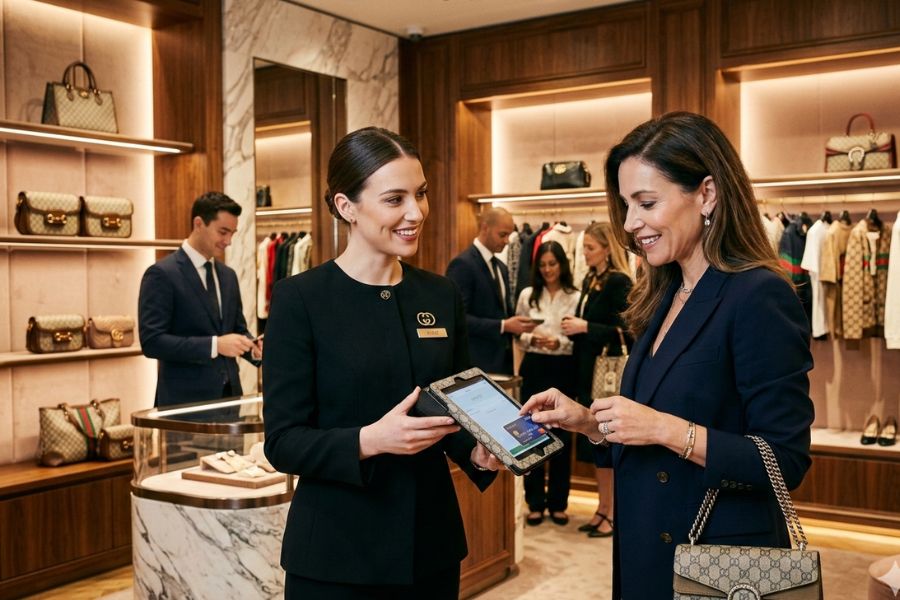
- Mobile POS of Gucci enables secure checkout directly on the sales floor, allowing associates to complete transactions without interrupting personalized client engagement.
- Integrated POS infrastructure of Gucci also connects inventory, payments, and client profiles across boutique locations, maintaining operational control while preserving a refined in-store experience.
Gucci POS Strategy: Preserving Exclusivity While Scaling Operations
Gucci approaches point-of-sale as a brand governance system rather than a retail utility. Expansion across regions and channels needs consistency in brand control, restraint in operational design, and clarity in how data serves creative intent. Gucci POS decisions sit at the intersection of retail execution and house philosophy, shaping how growth unfolds without diluting exclusivity.
- Brand Governance Control: A tightly governed POS architecture supports global expansion while keeping local boutiques aligned with central brand rules; headquarters maintains visibility, store teams retain autonomy.
- Client Relationship Continuity: POS-linked client records support personal recognition across locations and touchpoints; transaction history informs service depth without driving promotional behavior.
- Inventory Scarcity Management: Stock visibility guides allocation and replenishment without encouraging demand chasing; curated availability reinforces scarcity as a brand signal.
- Boutique Experience Preservation: Checkout flows remain discreet and staff-led; technology stays secondary to conversation, styling, and atmosphere.
- Cross-Channel Alignment: Store and digital operations connect at the data level; customer journeys remain coherent without exposing system mechanics.
Risk and Transaction Oversight: Payment controls and authorization logic protect high-value transactions across markets; compliance operates quietly without disrupting the in-store experience.
Read more: TOP 3 Apparel Store POS System Reviews
How Gucci POS Enables Secure, Mobile Checkout in Boutique Environments
Secure, mobile checkout in Gucci POS extends beyond payment mobility alone. It depends on systems that protect transactions while preserving service flow and brand restraint. This section outlines how POS supports security, associate-led checkout, and global consistency without disrupting the boutique experience.
Boutique-First Mobility Design
Gucci POS mobile checkout model reflects where luxury foot traffic and purchase behavior are heading, with global personal luxury goods sales now supported by more than 500 directly operated stores worldwide, anchoring face-to-face service and boutique rituals rather than dispersed retail points. Mobile POS empowers sales associates to complete transactions at the moment clients are most engaged, shortening checkout without undermining the curated atmosphere of high-end boutiques.
Industry observations indicate a broader shift toward mobile POS in luxury retail, where handheld devices have been fitted to match elevated clienteling practices that tie payment moments to the service narrative rather than to queue-based counters. This supports a spatial flow that privileges consultation and personalization over mechanistic checkout interactions.
Payment Security Without Visual Intrusion
Luxury transactions tend to be higher in ticket value than mass retail, and payment controls must absorb that reality without detracting from the client experience. Payments of four figures or more are commonplace in premium leather goods and accessories, which represent a meaningful share of Gucci’s assortment in boutiques globally.
POS architectures in this context embed encryption and authorization logic into every transaction step behind the scenes so that fraud controls operate without presenting clients with additional screens, taps, or steps.
Luxury buyers also show integrated shopping behavior where digital orientation informs in-store decisions; as many as 98% of luxury consumers browse online before engaging in person, pushing retailers to respect data fidelity and security across channels. Gucci POS security approach respects this trend by keeping sensitive data protections invisible yet robust at checkout.
►►► Optimal solution set for businesses: Multi store POS, Next-gen POS, Inventory Management Software (MSI), Self Service, Automation, Backorders

Read more: Tips to Manage your entire brand with a multi-store POS for luxury retail chains
Staff-Led Checkout Authority
Performance data across luxury retail suggests that when a single associate shepherds the interaction from discovery through payment, repeat visit rates climb. Internal and industry readings show that consultative selling correlates strongly with loyalty and lifetime value, especially in premium categories where the average sale can outpace industry norms by three to five times.
Gucci POS mobile checkout permissions reflect this insight, enabling trained associates to handle adjustments and after-sales services without fragmenting responsibility between departments.
This structure maintains continuity of the personal relationship, aligning with luxury expectations that service be holistic and bespoke rather than segmented by task or physical location.
Consistency Across Global Boutique Networks
Gucci’s retail footprint spans more than 520 directly operated stores around the world, and payment expectations vary widely by region. In parts of Asia, mobile wallets and wallet-linked payments dominate in-store behavior, while Europe and North America still see predominance of traditional card transactions. Mobile checkout logic within Gucci POS system accommodates such variation while keeping service gestures consistent across markets.
Luxury omnichannel readiness is a growing expectation among affluent consumers globally, with industry research indicating that more than three-quarters of luxury shoppers want consistent experiences across all channels. Gucci’s mobile checkout standards reflect this, making service uniform without flattening cultural or payment nuances.
Read more: Pros & Cons of Setting Up A POS System for Boutique
ConnectPOS – Bringing Secure Mobile Checkout to Luxury and Premium Retailers
ConnectPOS is a cloud-based Point of Sale platform built for retailers operating between digital convenience and high-touch, in-store service. The system supports premium brick-and-mortar boutiques where mobility, data control, and client relationships must coexist without disrupting the retail atmosphere. Rather than positioning POS as a transactional endpoint, ConnectPOS functions as an operational backbone that supports service-led selling and cross-channel consistency.
- Mobile-First Approach: ConnectPOS allows sales associates to step away from fixed checkout counters and engage clients directly on the showroom floor, with mobile POS checkout supporting transactions at the moment of interaction and keeping smooth service.
- Elite Clienteling: ConnectPOS shifts POS usage away from simple transaction handling toward relationship-driven selling. Associates gain access to relevant customer context at the point of interaction, supporting more informed and personalized engagement.
- 360-Degree Clienteling: Unified customer profiles consolidate global purchase history, wish lists, and style preferences. This consolidated view allows staff to tailor recommendations and service interactions based on familiarity and past behavior rather than isolated store data.
- PCI-DSS Compliance: The platform complies with PCI-DSS standards, applying encrypted payment processing and tokenization to protect sensitive transaction data. These controls support high-value payments while remaining invisible to the customer experience.
- Real-Time Inventory Management: ConnectPOS tracks high-end SKUs and RFID-tagged items across locations in real time. Inventory accuracy supports allocation planning, limits shrinkage, and helps prevent stockouts across boutique networks.
- Contactless Mobile Payments: The system supports modern payment methods including Tap to Pay on iPhone, Apple Pay, Google Pay, and link-based remote payments. Associates can adapt payment handling to client preference without altering service posture.
- Offline Mode POS: Full POS functionality remains available during internet outages. Transactions and data are stored locally and automatically synchronized once connectivity is restored, maintaining operational continuity.
- Multi-Currency & Tax Support: ConnectPOS manages international currency conversion and regional tax logic automatically. This capability supports boutiques serving global travelers while keeping checkout interactions clear and controlled.
- Advanced Analytics: Real-time reporting provides insight into staff activity, product performance, and customer lifetime value. Management teams gain visibility into retail performance without separating analytics from day-to-day operations.
Read more: Inside the Nike POS: Powering the Ultimate Omnichannel Customer Experience
FAQs
How does secure, mobile checkout support exclusivity rather than speed?
Mobile checkout inside Gucci boutiques is designed to preserve service flow, not accelerate transactions for volume. Associates complete payments wherever the interaction feels natural, keeping attention on product and conversation while security controls operate quietly in the background.
How does POS mobility affect the role of sales associates?
POS mobility reinforces associate ownership of the full client journey. The same person who advises on selection remains present through payment and follow-up, strengthening personal trust and reinforcing the perception of bespoke service.
How does Gucci maintain consistency across global boutiques with different payment norms?
POS rules standardize service behavior and governance at a global level, while local payment methods and regulatory requirements adapt within those boundaries. Clients encounter familiar service gestures regardless of location.
How can platforms like ConnectPOS support this exclusivity-at-scale model in practice?
ConnectPOS supports secure mobile checkout, unified client profiles, and centralized governance while allowing associates to work freely on the boutique floor. Its cloud-based architecture connects inventory, payments, and customer data across locations, supporting scale without compromising service intimacy.
Conclusion
Gucci POS strategy shows that scaling luxury retail goes beyond adding mobile devices or accepting new payment types. Discipline in governance, restraint in data usage, and consistency in keeping associates at the center of the client relationship define how growth unfolds. Secure, mobile checkout functions as a quiet support layer that sustains service continuity without drawing attention to technology.
Retailers facing similar growth pressures can draw practical lessons from this approach. ConnectPOS works with premium and luxury brands to support mobile checkout, unified client profiles, and centralized oversight while preserving boutique intimacy. Connect with the ConnectPOS team to explore how exclusivity can be maintained as operations expand.
►►► Optimal solution set for businesses: Shopify POS, Magento POS, BigCommerce POS, WooCommerce POS, NetSuite POS, E-Commerce POS