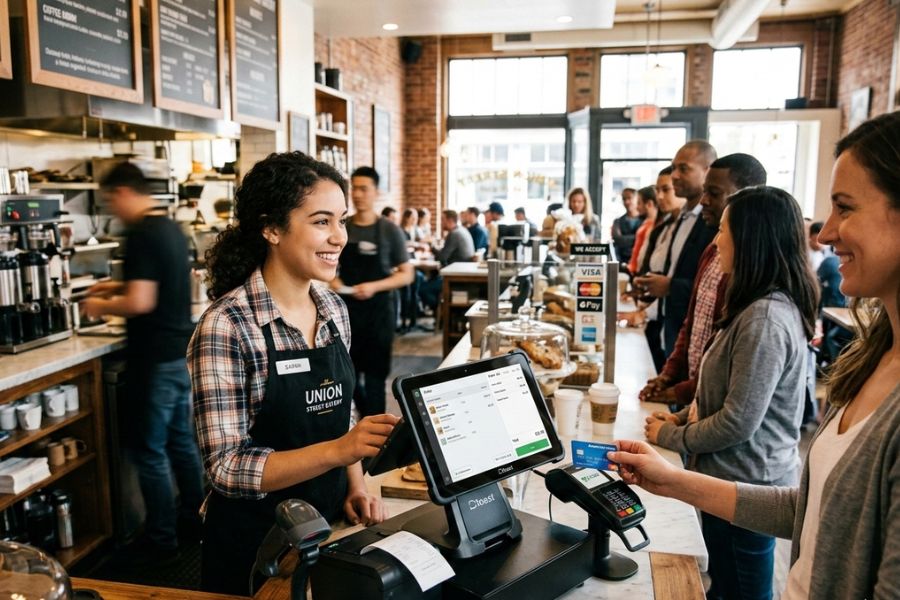
To succeed today, businesses cannot rely on generic, off-the-shelf Point of Sale (POS) systems, which often become liabilities. These standardized solutions force companies to make compromises, leading to operational friction that harms customer experience and limits future growth. Shifting focus from basic customization to strategic custom POS development is essential for achieving deep integration, efficiency, and long-term viability. To assist leaders in navigating this crucial technology investment, this guide from ConnectPOS outlines the core strategies necessary to achieve the best possible outcomes from custom POS software development services.
Highlights:
- Businesses choose custom POS for perfect operational fit and superior long-term returns. Tailored systems drive differentiation by supporting unique workflows and scaling effortlessly.
- Necessary components must secure deep integration (sales, inventory, CRM). These tools provide real-time analytics and top security, establishing a single source for data.
- Getting results demands defining workflows first and choosing partners based on industry experience. Success relies on prioritizing deep system integration and planning for continuous updates and code ownership.
Why Businesses Choose Custom POS Software Development Services
Choosing custom POS software development services is a strategic move that drives efficiency, improves customer experience, and secures long-term growth beyond the limitations of off-the-shelf systems.
- Tailored to Unique Operations: Custom POS software is built to perfectly mirror a business’s specific workflows and sales models. This precise fit optimizes efficiency, reduces errors, and minimizes staff training by functioning exactly as the business operates, accommodating specialized needs like complex inventory or unique service management.
- Scalability & Long-Term ROI:The system is engineered for long-term investment and scalability, easily handling growth in volume or locations without costly overhauls. While the initial investment is strategic, it avoids recurring subscription fees and the expense of constant workarounds, ensuring a high return on investment (ROI) over time.
- Enhanced Integration Capability: Custom development guarantees flawless data exchange by specifically integrating with critical business tools like Accounting Software, E-commerce, and CRM/ERP Systems. This eliminates data silos and manual entry, providing automated synchronization and a single, reliable source of truth across the organization.
- Improved Data Control & Security: Businesses gain complete authority over their data, maintaining full ownership of the source code and all sales information, which leads to greater control over access and recovery. Security features are purpose-built to meet industry compliance and defend against unique threats, resulting in a far more robust protection level than generic systems.
- Competitive Differentiation: A custom POS solution provides a significant strategic edge by allowing the business to implement proprietary features that enhance the customer journey, such as hyper-personalized loyalty programs or unique order flows. The resulting software becomes a difficult-to-replicate operational asset, driving market distinction.
Key Features to Consider in Your Custom POS Software
The development of custom POS software requires a strategic feature set that addresses contemporary operational demands, leverages data for competitive advantage, and secures long-term system viability. Strategic feature selection of custom POS software development services is crucial for maximizing productivity and ROI.
Multi-channel Sales and Payment Support
A modern custom POS must function as the central hub for smooth omnichannel commerce, managing sales across physical stores, e-commerce, and mobile apps. This guarantees customers experience a unified journey, allowing for consistent pricing, unified inventory visibility, and the ability to start a transaction in one channel and complete it in another without data friction.
Crucially, the system must support diverse and flexible payment methods, including mobile wallets, tokenized credit cards, and BNPL schemes, all while maintaining strict PCI DSS compliance. Providing these multiple options is a strategic move, as data shows it reduces checkout abandonment and improves transaction completion rates, underpinning the system’s ability to drive sales growth.
Inventory and Supplier Management
Custom POS software development services guarantee efficient inventory management is critical for minimizing capital tied up in stock and preventing lost sales. The custom POS must provide real-time, perpetual inventory tracking across all sales channels and locations.
This allows for immediate stock level updates and supports advanced features like automated low-stock alerts and predictive demand forecasting, which are essential for optimizing the purchasing cycle and minimizing waste.
Integrating supplier management transforms the POS into a core supply chain engine. The system should automate purchase orders (POs), track deliveries, and manage vendor performance based on transparent data. This integration reduces manual administrative load, provides control over pricing, and improves gross margin by optimizing the entire product sourcing and stocking lifecycle.
CRM and Loyalty Programs
Integrating Customer Relationship Management (CRM) and loyalty capabilities directly into the POS shifts the focus from transactions to sustained customer engagement. A unified profile is instantly updated at the point of sale, capturing purchase history, preferences, and loyalty status. Snappy’s 2024 Customer Loyalty Study found that 76% of respondents report they will spend more money with companies when they are part of the brand’s loyalty program.
This deep integration enables data-driven personalization. Associates can receive real-time data prompts to suggest tailored upsells or apply personalized offers, directly boosting the average transaction value. Furthermore, the unified dataset fuels automated, targeted marketing campaigns based on POS activity, maximizing marketing ROI compared to broad, untargeted promotions.
Real-time Analytics and Dashboards
The ability to access and act on data instantly is a critical differentiator in modern commerce. A custom POS, resulting from custom POS software development services, must feature a robust engine for real-time analytics that aggregates data from all sales, inventory, and customer interactions. This data is displayed via configurable dashboards showing critical KPIs, such as sales volume, average order value, and transaction error rates, as they occur.
This instant transparency enables agile decision-making. Managers can immediately identify and correct operational anomalies, such as an underperforming promotion or a process bottleneck, without waiting for end-of-day reports. This allows for sophisticated predictive analytics, optimizing staffing schedules, and dynamically adjusting pricing or promotion strategies to maximize revenue.
Security, Encryption, and Regulatory Compliance
Given the sensitivity of payment data, security is foundational. A custom POS must employ end-to-end encryption (E2EE) for all transmitted data and utilize certified, PCI DSS-compliant gateways for payment processing. This strategy minimizes the system’s exposure to sensitive cardholder data, drastically reducing security risks and audit scope.
Beyond technical security, the system must enforce rigorous role-based permissions (RBAC) to limit employee access to only necessary functions. Crucially, the custom software must be developed with proactive adherence to international data protection regulations (e.g., GDPR, CCPA). This focus on compliance avoids costly retrofitting and protects the business from severe financial and reputational penalties.
Mobile Access and Cross-Platform Scalability
To support modern, dynamic operations, a custom POS must extend functionality beyond the fixed terminal via Mobile Point of Sale (mPOS), accessible on tablets or smartphones. This capability is essential for queue-busting, tableside service, and pop-up retail, enhancing the customer experience by reducing wait times and enabling personalized service with real-time data access on the sales floor.
The solution must be built on an architecture that guarantees cross-platform scalability, both vertically (handling high volume) and horizontally (accommodating new locations). A cloud-native or microservices architecture allows features to be updated and scaled independently. This design guarantees the system is future-proof, enabling rapid deployment of new technologies and maintaining consistent performance regardless of geographic expansion.
How to Get The Best Results for Your Business?
Achieving optimal results from custom POS software development services requires a strategic focus on planning, partnership, and future readiness. It is a process that demands deep operational insight and technical foresight.
- Define Operations Before Technology: Before selecting any technology, you must clearly map out your exact business workflows. A detailed operational blueprint that defines how the POS handles unique processes (e.g., custom returns or specific service pricing) guarantees the software is designed to solve real-world problems and maximize staff efficiency from the start, avoiding costly rework later.
- Prioritize Integration Over Isolation:The core value of a custom POS system lies in its ability to function as a central data hub. Deep, two-way integration with your most critical business systems is essential: E-commerce (for inventory sync), ERP/Accounting (for automated reporting), and CRM (for personalized engagement). These connections eliminate data silos, providing the single, unified source of truth required for data-driven decisions.
- Select the Right Development Partner: Success relies on choosing a partner with a proven track record in your specific industry and experience with complex integrations. The partner should propose a modern, scalable cloud-native architecture. Crucially, securing the contract explicitly grants your business full ownership of the source code and intellectual property (IP).
- Prioritize Security and Compliance From Day One: Security must be foundational. Implement end-to-end encryption (E2EE) for data, use certified PCI DSS-compliant payment gateways, and enforce Role-Based Access Controls (RBAC). This proactive approach secures data safety and regulatory adherence right from the development phase.
- Plan for Continuous Evolution: A custom POS is a long-term asset. Budget for ongoing maintenance, security patching, and iterative feature development. This continuous investment guarantees the system remains safe, highly effective, and flexible enough to integrate future innovations and adapt to changing market needs without a complete overhaul.
ConnectPOS: A Proven Model Of Custom POS Software Development Services For Business Success
ConnectPOS functions as a flexible platform for omnichannel retail, avoiding the limitations of a rigid system. It succeeds because it connects smoothly with major e-commerce and ERP systems, forming the base for unified commerce.
It uses a strong API and modular design so businesses can adapt core functions like checkout, inventory control, and customer monitoring to their precise processes. This delivers the advantages of a bespoke system without the high cost of building one from scratch. This hybrid customizability makes ConnectPOS a reliable route to business achievement, providing both adaptability and dependable operation.
- Omnichannel Synchronization: It keeps data consistent across physical stores and online platforms. Inventory and customer information sync instantly, supporting services like Buy Online, Pick Up In-Store (BOPIS) and easy returns, which raise customer contentment.
- High Performance and Reliability: The design prioritizes speed and dependable function, especially during busy times. An “offline mode” keeps transactions running if the internet fails, preventing lost sales.
- Superior Scalability: The system handles high transaction volume and growth into new stores or markets without slowing down. This supports long-term growth and return on investment (ROI).
- Deep Customization: Businesses change the user interface (UX) for cashiers and adjust complex back-end logic for specific loyalty setups, pricing tiers, and unique tax rules, gaining a competitive advantage.
- Wide Payment Acceptance: It supports a broad array of connected payment methods and hardware, keeping payment processing flexible and compliant, which helps conversion rates.
- Data Control and Analysis: The solution centralizes sales and customer data, giving businesses immediate analysis and dashboards. This allows fast insight into operations and customer patterns, guiding better inventory and marketing choices.
Conclusion
Achieving superior results from custom POS software development services relies on strategic planning and partnership selection, not just technology. Success requires establishing detailed operational blueprints first, implementing deep integration with core systems, and securing a reliable, future-proof architecture. Success is measured by the system’s ability to drive competitive differentiation and support growth.
If you’re looking for a trusted partner to design, build, or optimize a custom POS ecosystem, ConnectPOS provides the expertise, technology foundation, and integration capabilities to help you move faster with confidence. Contact ConnectPOS today!
FAQs Custom POS Software Development Services
What is the primary advantage of custom POS software development services?
The main advantage is precise alignment with your unique business processes. Custom software mirrors your exact operations, unlike generic systems that force adaptation. This leads to optimized efficiency, faster transactions, and better long-term ROI because the system evolves with your specific needs.
Which systems are most important to integrate with the custom POS?
Integration is critical for unified commerce. The most important connections are with:
- E-commerce POS Platform: For real-time inventory and customer synchronization.
- Accounting/ERP Software: For automated financial reporting.
- CRM: For personalized service based on purchase history.
- Payment Gateways: For safe, compliant payment processing.
Why choose a customizable platform like ConnectPOS instead of building a POS completely from scratch?
Choosing a customizable platform reduces initial costs and time-to-market by providing a reliable foundation (like payment processing and security) upfront. This allows your team to focus budget and time only on adding proprietary, differentiating features that truly optimize your unique workflows for a faster competitive edge.
►►► Optimal solution set for businesses: Shopify POS, Magento POS, BigCommerce POS, WooCommerce POS, NetSuite POS, E-Commerce POS