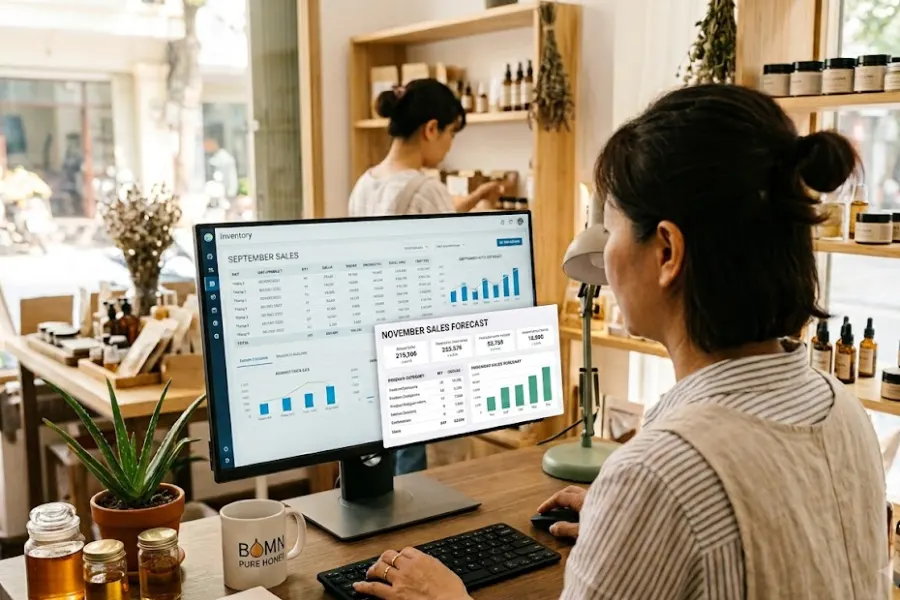
Retail businesses collect vast amounts of sales, inventory, and customer data, but without effective retail POS data analysis, valuable insights often go unused. This can result in poor forecasting, inventory issues, missed revenue opportunities, and weaker customer experiences. AI transforms POS data into actionable intelligence by identifying trends, predicting demand, optimizing stock levels, and personalizing customer interactions.
In this article, we will explore how AI-powered retail POS data analysis enables businesses to improve operational efficiency, increase profitability, enhance customer satisfaction, and gain a competitive advantage in an increasingly data-driven retail market.
Highlights
- AI transforms static POS data into forward-looking intelligence, accurately forecasting consumer demand, optimizing inventory, and automating pricing.
The Role of AI in Retail POS Data Analysis
Traditional reporting tells retailers what happened yesterday. AI goes much further by turning standard retail POS data analysis into a forward-looking strategy that explains why events happened, predicts what will happen next, and recommends the best course of action.
AI continuously analyzes POS transactions alongside customer profiles, inventory records, seasonal trends, supplier performance, marketing campaigns, and external factors such as weather or holidays. Machine learning models improve over time, becoming increasingly accurate as more retail data is collected.
The business impact of AI is becoming increasingly evident across industries, including retail. According to McKinsey’s “The State of AI” report, 65% of organizations regularly use generative AI in at least one business function, nearly double the percentage reported just ten months earlier, reflecting the rapid acceleration of AI adoption for business decision-making.
Rather than manually reviewing spreadsheets, store managers receive automated recommendations, predictive alerts, and intelligent dashboards that simplify strategic planning. When transforming raw transaction data into predictive insights, AI helps retailers react faster to market changes while improving operational efficiency and customer satisfaction.
Key AI capabilities include:
- Predictive analytics
- Pattern recognition
- Customer segmentation
- Automated reporting
- Real-time anomaly detection
- Natural language insights
- Recommendation engines
Strategic Decisions Retailers Can Make Using AI-Powered POS Data
Harnessing AI allows retailers to make precise, high-impact decisions across all facets of their business. Here are the core strategic areas where AI-powered retail POS data analysis shines:
AI-Powered Demand Forecasting and Inventory Management
AI models analyze historical POS data alongside external factors like weather, local events, and economic trends to predict future product demand with pinpoint accuracy. This prevents costly overstocking and frustrating stockouts, guaranteeing capital is tied up only in inventory that will actually sell.
A regional beverage distributor used AI to analyze POS data alongside real-time weather forecasts. When a heatwave was predicted for the upcoming weekend, the AI automatically increased supplier orders for cold beverages and bottled water while scaling back on hot coffee inventory.
Customized Marketing Campaigns and Customer Loyalty Enhancement
When analyzing individual purchasing histories and frequencies, AI segments your customers based on their true lifetime value. This enables you to deploy hyper-personalized marketing campaigns that offer tailored discounts and recommendations, dramatically boosting conversion rates and fostering deep brand loyalty.
For instance, a specialty pet-supply retailer uses AI to monitor customers’ purchasing cycles. The system flags that a specific customer buys a 30-pound bag of premium grain-free dog food every 45 to 50 days. On day 40 of the cycle, the AI automatically triggers a personalized SMS discount for that exact brand of dog food, accompanied by a recommendation for a complementary joint-health treat.
Smart and Flexible Pricing Optimization
Dynamic pricing is no longer just for airlines. AI algorithms continuously evaluate competitor pricing, current inventory levels, and real-time demand to suggest the optimal price points for your products, maximizing profit margins without deterring price-sensitive shoppers.
It allows for algorithmic markdown and promotional strategies. If an item has a low sales velocity and an upcoming expiration or end-of-season date, the AI can execute incremental micro-markdowns to clear shelf space. Conversely, if a specific item is trending heavily on social media and flying off the shelves, the system can subtly adjust the price upward to capture maximum margin.
Data-Driven Store Planning and Workforce Allocation
Deep retail POS data analysis can reveal peak shopping hours down to the minute. AI uses this foot traffic and transaction volume data to help managers optimize staff scheduling, guarantee enough hands are on deck during rushes to maintain excellent customer service, while saving on labor costs during lulls.
For example, a bustling home improvement center discovered that while foot traffic spiked right at 5:00 PM as contractors left job sites, actual POS transaction volumes didn’t peak until 5:30 PM because customers spent an average of 30 minutes browsing the aisles.
Advanced Fraud Prevention and Transaction Monitoring
Retail shrinkage is a massive issue, but AI serves as a tireless digital security guard. AI continuously monitors POS transactions to identify unusual activities, including excessive voids, frequent suspicious returns, and irregular employee discount usage, enabling retailers to detect potential internal or external fraud in real time.
According to the National Retail Federation, retail shrinkage has ballooned into an annual problem costing the industry over $112 billion, driven heavily by internal theft, systemic errors, and organized retail crime. Rather than waiting for end-of-month inventory audits to discover missing revenue, AI uses anomaly detection to flag suspicious patterns such as excessive mid-day voids, frequent cash returns without receipts, and irregular employee discount usage, enabling retailers to intervene immediately.
Why Retailers Should Consider ConnectPOS for AI-Driven Retail POS Data Analysis
To truly leverage the power of artificial intelligence, retailers need a foundation that can consolidate multi-channel data in real time. ConnectPOS bridges the gap between raw transactional data and AI-driven strategic execution.
Designed as a high-speed, omnichannel POS solution, ConnectPOS integrates seamlessly with major e-commerce platforms like Shopify, Magento, and BigCommerce, as well as robust ERP systems like NetSuite.
Discover how ConnectPOS turns AI-driven retail pos data analysis into a seamless operational reality:
- Unified Omnichannel Data Pool: AI is only as good as the data it consumes. ConnectPOS synchronizes in-store sales, online purchases, warehouse inventory, and customer profiles into a centralized database, giving your AI models a complete, unfragmented view of your operations.
- Real-Time Data Architecture: Instead of batch-processing data at the end of the day, ConnectPOS updates transactions and stock levels instantly.
- Open API and Smooth Integrations: Transitioning into predictive retail requires a tech stack that communicates smoothly. The flexible architecture of ConnectPOS allows businesses to readily feed clean structured POS data directly into specialized AI forecasting engines and recommendation platforms.
- Offline Mode with Local Data Synchronization: AI analysis can be severely disrupted by data gaps caused by unstable internet connections. ConnectPOS features a robust offline mode that ensures in-store transactions, cash flows, and basic customer interactions continue to log locally.
- Granular Employee Performance and Operational Logging: To feed AI workforce allocation and fraud detection engines, a POS needs to track more than just sales totals. ConnectPOS tracks detailed user actions, including exact shift login times, transaction durations, mid-day voids, and returns
- Multi-Store and Multi-Warehouse Inventory Visibility: For AI-powered demand forecasting to prevent stockouts or overstocking, it needs a clear picture of the entire supply chain. ConnectPOS tracks inventory movements across multiple brick-and-mortar locations and central warehouses simultaneously.
Best Practices for Implementing AI in Retail POS Data Analysis
Deploying AI within your retail operations requires a strategic framework to ensure a high return on investment (ROI). Consider these foundational best practices:
- Prioritize Data Hygiene: AI models thrive on accurate inputs. Ensure your staff is properly trained on POS operations to avoid duplicate customer profiles, missed stock logs, or incorrect product tagging. Clean data leads to clean, reliable predictions.
- Start with a Specific Business Problem: Instead of trying to revolutionize your entire operation overnight, focus on a high-friction area first. Begin with an easily measurable objective, such as reducing stockouts on top-selling items or automating employee scheduling during weekend rushes.
- Blend Machine Intelligence with Human Expertise: AI provides recommendations based on mathematical patterns, but it lacks local contextual awareness. Use AI insights to guide your store managers, not replace them. Combine algorithmic data with human judgment regarding community relationships and brand identity.
- Monitor and Re-evaluate Regularly: Retail environments change rapidly. Continuously review the accuracy of your demand forecasts and the conversion rates of your automated marketing campaigns to fine-tune your AI parameters over time.
FAQs: Retail POS Data Analysis
- How does AI improve retail POS data analysis?
AI automatically identifies patterns, predicts future trends, detects anomalies, and generates actionable recommendations much faster than traditional reporting methods, enabling retailers to make proactive business decisions.
- Can small retailers benefit from AI-powered POS analytics?
Absolutely. Cloud-based POS platforms increasingly provide AI-powered reporting at affordable pricing, allowing small and medium-sized retailers to improve inventory management, marketing, and operational efficiency without enterprise-level budgets.
- What types of data can be analyzed from a POS system?
Modern POS systems capture a wide array of valuable data points beyond basic currency transactions, including:
- Transactional Data
- Inventory Data
- Customer Data
- Operational Data
Wrap Up
In sum, as retail competition becomes increasingly data-driven, businesses can no longer rely solely on historical reports or manual decision-making. Retail POS data analysis powered by AI enables retailers to forecast demand more accurately, optimize inventory, personalize customer experiences, strengthen fraud prevention, and improve operational efficiency across every store location.
ConnectPOS provides the unified omnichannel infrastructure and advanced reporting capabilities businesses need to support AI-driven decision-making today while preparing for future retail innovation. If you’re ready to transform your retail data into smarter business strategies, contact us to help your business stay ahead of the competition.
►►► Optimal solution set for businesses: Shopify POS, Magento POS, BigCommerce POS, WooCommerce POS, NetSuite POS, E-Commerce POS