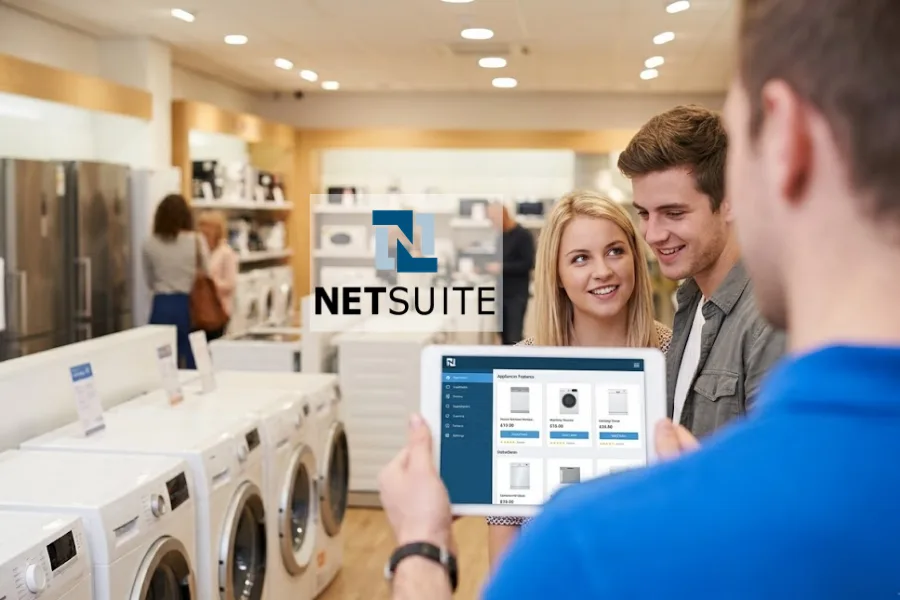
Retail operations today are rapidly evolving as businesses strive to deliver faster checkout, personalized service, and seamless omnichannel experiences. One of the most impactful technologies enabling this transformation is the NetSuite mobile POS. By allowing store associates to complete transactions anywhere in the store using tablets or smartphones, a mobile POS system significantly improves customer experience and operational efficiency.
In this article, ConnectPOS will explore what NetSuite mobile POS is, how it impacts store operations, the key features retailers should consider, and the leading NetSuite mobile POS solutions for 2026.
Highlights
- NetSuite Mobile POS drives efficiency through real-time bi-directional sync, offline transaction support, and omnichannel fulfillment, enabling seamless “line busting” and personalized clienteling to eliminate operational bottlenecks.
- Leading providers include ConnectPOS for omnichannel flexibility, SuiteCommerce InStore for native integration, SuitePOS for iOS-centric speed, and Shopify POS for commerce-first brands using NetSuite connectors.
Deep Understanding of NetSuite Mobile POS
A NetSuite mobile POS is a portable point-of-sale system that operates on mobile devices such as tablets and smartphones, designed specifically to integrate deeply with the NetSuite ERP. Unlike traditional legacy systems that often rely on delayed “batch” updates, a modern mobile POS utilizes cloud-based architecture to provide a constant, bi-directional flow of data.
According to recent industry insights from ERP Peers, the global cloud ERP market is projected to reach $76.17 billion in 2026, underscoring the massive shift toward integrated cloud environments.
When a retailer adopts a mobile POS, they are essentially putting the power of their entire ERP in the palm of an associate’s hand. This allows for instant processing of payments via mobile wallets or credit cards, immediate access to global inventory, and a significantly more interactive service model compared to fixed terminals.
Impact on NetSuite Mobile POS: Important to Store Operations
The transition to a NetSuite mobile POS environment transforms a retail store from a simple fulfillment center into a high-efficiency experience hub. When deploying the POS technology, businesses can address long-standing operational bottlenecks that previously limited growth.
Line Busting & Reduced Wait Times
One of the most immediate benefits of a NetSuite mobile POS is the ability to perform “line busting.” Instead of customers waiting in a single, slow-moving queue, staff can walk the floor and process checkouts on the spot.
- Faster Checkout: Transactions are completed in seconds, not minutes.
- Improved Satisfaction: Decreasing wait times is the #1 factor in improving in-store NPS (Net Promoter Scores).
- Higher Conversion: Mobile checkout prevents “abandoned baskets” caused by long lines
Unified Inventory Visibility
With a NetSuite mobile POS, the “out of stock” excuse disappears. Associates can check real-time inventory across:
- Physical store locations
- Regional warehouses
- Online web stores (eCommerce)
This confirms that if a product isn’t on the shelf, the staff can use their NetSuite mobile POS to order it for home delivery, capturing a sale that would otherwise be lost.
Clienteling & Personalization
Data from ConnectPOS indicates that 68% of consumers expect store associates to have access to their online order history. This POS provides this “clienteling” capability, giving staff access to:
- Customer purchase history and preferences.
- Personalized product recommendations based on previous browsing.
- Loyalty program status and available rewards.
Operational Efficiency
Beyond the customer-facing benefits, the POS streamlines the “back office” work. Digital sales reporting and automated reconciliation mean managers spend less time on spreadsheets and more time on the floor. Real-time data flow guarantees that accounting and sales teams always have a “single source of truth.”
Key Features to Look for in a NetSuite Mobile POS
Not all systems are created equal; a high-performing NetSuite mobile POS in 2026 must offer more than just a payment interface. It must serve as the technical bridge between your physical assets and your digital strategy.
- Real-time Bi-directional Sync: Ensures instant synchronization between the NetSuite Mobile POS and NetSuite ERP so that sales, inventory, customer data, pricing, and promotions are always accurate and up to date.
- Offline Transaction Support: Allows stores to continue processing transactions even when the internet connection is lost, with data automatically syncing to NetSuite once connectivity is restored.
- Omnichannel Fulfillment: Supports modern retail workflows such as Buy Online Pickup In Store (BOPIS), ship-from-store, endless aisle ordering, and cross-channel returns to deliver a seamless shopping experience across channels.
- Hardware Compatibility: Works with common retail hardware including tablets, barcode scanners, receipt printers, payment terminals, and cash drawers, enabling flexible and scalable store operations.
Top NetSuite Mobile POS Solutions for 2026
To help you navigate the market, we have highlighted the leading NetSuite mobile POS solutions currently driving retail innovation.
ConnectPOS (Omnichannel Specialist)
ConnectPOS is a cloud-based omnichannel POS solution designed to integrate deeply with enterprise systems like Oracle NetSuite. It provides retailers with real-time synchronization between in-store transactions and backend ERP data, helping businesses manage inventory, sales, and customer information across multiple channels from a single platform.
The system is widely used by retailers in industries such as fashion, electronics, and lifestyle products that require seamless integration between physical stores and eCommerce platforms.
Key Features:
- Zero Integration Lag: Since it is native, there is no “sync”, data is live the moment it is entered.
- Unified Customer Profile: Access 360-degree customer views, including online browsing history and past store purchases.
- Native Reporting: All retail sales data is immediately available in standard NetSuite dashboards and SuiteAnalytics.
- Full SuiteCommerce Integration: Seamlessly handles BOPIS (Buy Online, Pick Up In Store) and returns across channels.
Pricing:
- Starter Plan: Starts from approximately $49/month for small retailers with essential POS features.
- Standard Plan: Starts from approximately $79/month, offering more advanced POS capabilities and integrations.
- Professional Plan: Starts from approximately $99/month, designed for retailers requiring more advanced features and customization.
- Enterprise Pricing: Available with custom quotes for larger businesses that need advanced integrations, multiple stores, dedicated support, and tailored solutions.
Best For: Enterprises fully committed to the NetSuite ecosystem who want a “single source of truth” without any external software layers.
NetSuite SuiteCommerce InStore (SCIS)
As the native NetSuite mobile POS solution, SuiteCommerce InStore (SCIS) offers the unique advantage of being built directly within the NetSuite ecosystem. This eliminates the need for third-party connectors or “syncing” altogether, as the POS and ERP share the same database in real time.
Key Features:
- Zero Integration Lag: Since it is native, there is no “sync”, data is live the moment it is entered.
- Unified Customer Profile: Access 360-degree customer views, including online browsing history and past store purchases.
- Native Reporting: All retail sales data is immediately available in standard NetSuite dashboards and SuiteAnalytics.
- Full SuiteCommerce Integration: Seamlessly handles BOPIS (Buy Online, Pick Up In Store) and returns across channels.
Pricing:
- Module Fee: Usually starts around $2,500/month as an add-on to the NetSuite platform.
- User Licenses: Standard NetSuite user fees (approx. $99–$199/user/month) apply.
Best For: Enterprises fully committed to the NetSuite ecosystem who want a “single source of truth” without any external software layers.
SuitePOS (by SuiteRetail)
SuitePOS is a high-performance POS specifically optimized for the Apple iOS environment. It is designed for speed, allowing store associates to process complex transactions in seconds while maintaining a clean, intuitive interface that mimics the simplicity of consumer apps.
Key Features:
- Apple iOS Native: Optimized for iPad and iPhone, offering a smooth, responsive touch interface.
- Speed-Centric Checkout: Capable of processing transactions in under 3 seconds to eliminate counter friction.
- Hybrid Architecture: Combines an offline-capable app with NetSuite-based backend components.
- Multi-Subsidiary Support: Fully compatible with NetSuite OneWorld for global retail operations.
Pricing:
- Unlimited Plan: Offers a per-transaction pricing model (ideal for seasonal or event-based retail).
- Enterprise Plan: Fixed monthly subscription tailored to large-scaleoperations; typically starts at $100–$200 per terminal/month.
Best For: Retailers who prioritize a fast, Apple-centric mobile experience and want to avoid complex middleware.
Shopify POS (via NetSuite Connector)
For brands that lead with their eCommerce presence, using Shopify POS as a NetSuite mobile POS is a popular strategy. By using a specialized connector (like Celigo or TM), retailers can use Shopify’s world-class retail interface while letting NetSuite handle the heavy lifting of back-office financials and global inventory.
Key Features:
- Best-in-Class UI: Access to the Shopify App Store for loyalty, marketing, and hardware extensions.
- Automated Sync: Connectors sync sales orders, refunds, and fulfillment status between Shopify and NetSuite.
- Multi-Channel Simplicity: Manage your online and physical store from a single Shopify admin panel.
- Global Payments: Deep integration with Shopify Payments for competitive processing rates.
Pricing:
- Shopify POS Pro: $89/month per location (plus Shopify platform fees starting at $39/mo).
- NetSuite Connector: Third-party connectors typically cost between $100 and $600/month depending on order volume.
Best For: Direct-to-Consumer (DTC) brands that already use Shopify and need to sync their growing physical store data into NetSuite ERP.
FAQs: NetSuite Mobile POS
- Does NetSuite have its own native mobile POS?
Yes, NetSuite offers SuiteCommerce InStore (SCIS). However, many retailers choose third-party NetSuite mobile POS solutions like ConnectPOS for increased flexibility, lower hardware costs, and specialized omnichannel features
- What hardware do I need for a mobile POS?
Typically, you will need a tablet (iPad or Android), a mobile card reader (EMV/NFC), a portable barcode scanner, and a Bluetooth receipt printer. Some NetSuite mobile POS solutions also support “Tap to Pay” directly on smartphones.
- Can I manage multiple store locations through one mobile POS?
Absolutely. A cloud-based NetSuite mobile POS allows you to manage dozens of locations from a single NetSuite dashboard, providing centralized control over inventory, pricing, and staff across your entire network.
Wrap Up
Selecting the right NetSuite mobile POS is a strategic decision that directly impacts your store’s agility and your customers’ loyalty. As we have seen, the integration of real-time data, omnichannel fulfillment, and personalized clienteling is no longer optional; it is the baseline for success in 2026. By implementing a high-tier mobile POS, you guarantee that your store associates are equipped with the best tools to drive sales and operational efficiency.
If you are looking to modernize your retail operations and unlock the full potential of mobile POS, contact us to schedule a personalized demo.
►►► Optimal solution set for businesses: Shopify POS, Magento POS, BigCommerce POS, WooCommerce POS, NetSuite POS, E-Commerce POS