Retail performance isn’t driven by checkout speed alone. Apply POS system in US setups has changed how teams sell on the floor, how inventory gets checked in real time, and how customers move through the store without getting stuck at a counter.
In this guide, the ConnectPOS team breaks down what Apple uses in-store, what US retailers run on iPad and iPhone, and what features matter when you’re building a mobile-first store experience.
Highlights
- Apple POS setups move checkout off the cash wrap and into the sales floor, so associates can advise, check stock, and close sales anywhere.
- Apple Pay and NFC payments shorten checkout time and keep card data protected through tokenization and device-level security.
- In the US, “Apple POS” usually means two things: Apple’s internal system inside Apple Stores and iPad-based POS platforms used by third-party retailers.
Overview of Apple POS System in US
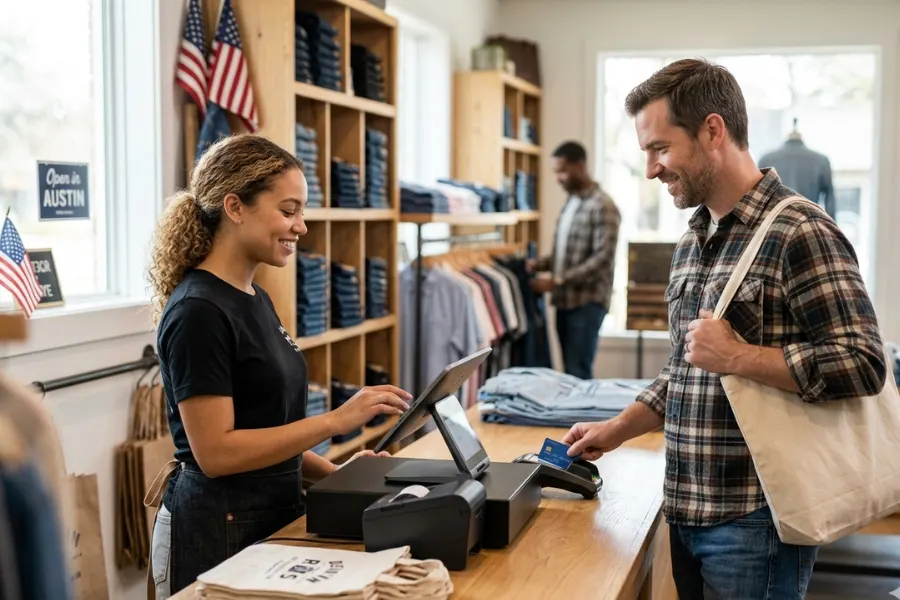
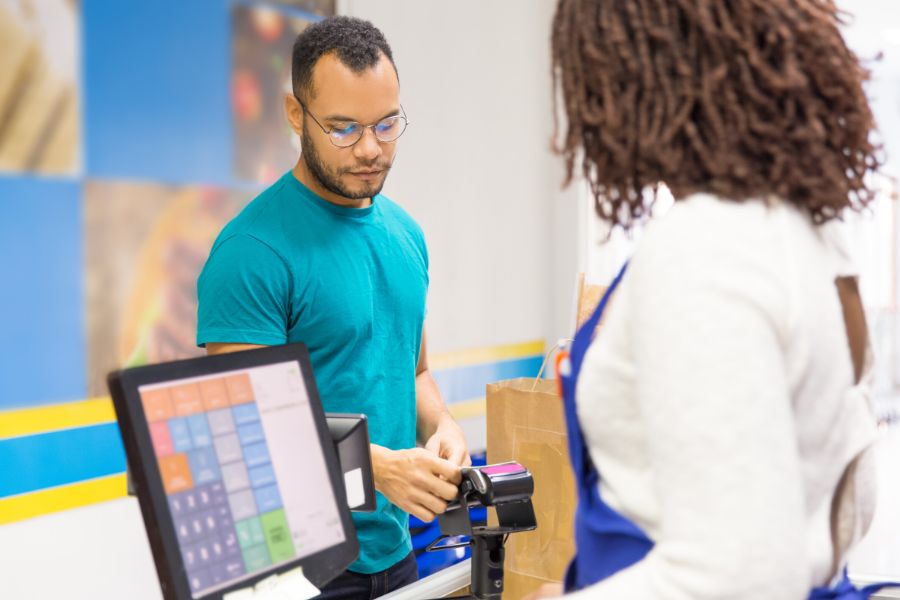
In the United States, an Apple POS system typically refers to a retail setup built on iPadOS and iOS devices, paired with POS software, payment methods like Apple Pay, and compatible peripherals. It also includes Apple’s own in-house POS environment inside official Apple Stores.
US retailers have widely adopted Apple hardware because it performs well at the counter and on the sales floor. iPad and iPhone setups are also easier to deploy across locations than many legacy terminals, especially when teams want mobile checkout, real-time inventory visibility, and a modern in-store experience.
Recent market signals point in the same direction: retailers keep shifting toward cloud POS and tablet-based configurations as store operations become more mobile and more data-driven.
- The retail segment accounts for approximately 35% of the overall POS terminal market share, with a significant portion of new installations favoring mobile and tablet-based configurations (Technavio).
- The U.S. point-of-sale software market is projected to grow to $9.8 billion by 2032, driven largely by the shift toward cloud-based iOS and Android applications
How Apple POS Works Inside US Apple Stores
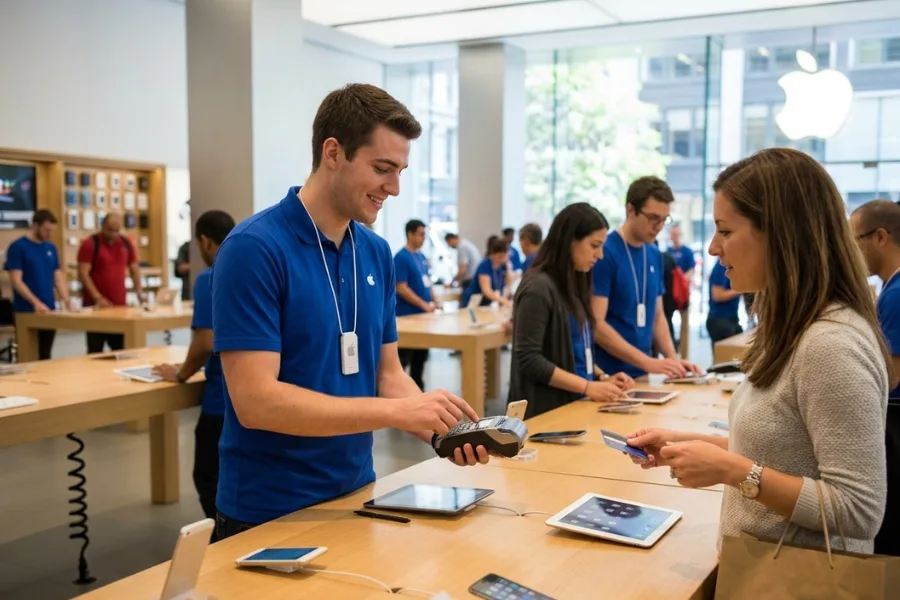
Apple Stores are known for “roaming retail.” Instead of pushing every transaction to a fixed checkout lane, associates complete sales anywhere on the floor using iPhone-based POS tools. Customers can browse, ask questions, compare models, and pay at the moment they’re ready.
Proprietary Customization: The “Isaac” System
Apple runs a proprietary internal POS platform (often referred to historically as “Isaac”). It’s built to connect selling, inventory visibility, and service workflows in one experience. Key practices often associated with Apple’s store model include:
- Real-time inventory visibility: Associates can check availability quickly and coordinate product retrieval without leaving the customer waiting.
- Hardware attachments for scanning and payments: Mobile setups can support barcode/RFID scanning and secure payment processing on the floor.
- Self-checkout for simple purchases: For low-complexity items like AirTags or phone cases, Apple empowers the customer’s own device to act as the POS. By scanning a barcode in the Apple Store app and paying via Apple Pay, the customer creates their own “express lane,” drastically reducing the workload on staff during peak hours.
Enhancing Efficiency through Practices
Apple’s POS success isn’t just about the software; it’s about the operational harmony it enables:
- Appointment Integration: The POS is tethered to the Genius Bar and Workshop schedules. An associate can see if a customer waiting for a repair is also a candidate for a trade-up, turning a service interaction into a sales opportunity.
- Digital-First Receipts: By tying every transaction to an Apple ID, the POS eliminates the friction of returns and warranty claims. There is no “searching for a receipt”; the system knows the customer’s entire purchase history instantly.
Apple POS System in the US – Which Solution Do They Use?
In the US market, Apple POS generally falls into two categories:
Apple’s Own Retail POS (In Apple Stores)
Apple’s internal tools support a floor-first model where checkout happens wherever the customer conversation ends. Receipts can be digital, purchase history is easy to find, and staff can shift between service and sales without switching systems.
- Self-Checkout via Apple Store App: For low-complexity items like AirTags or cables, Apple empowers the customer’s own device. By scanning a barcode in the Apple Store app and paying via Apple Pay, the customer creates their own “express lane,” bypassing staff entirely.
- Fluid Checkout: Payment happens wherever the conversation ends. This fluidity allows for instant product retrieval and emailed receipts, making the physical store feel as fast as an online click.
The Third-Party Ecosystem: iPad as the Core
Outside of Apple Stores, retailers build Apple-based POS setups using iPad and iPhone hardware with POS apps from vendors such as:
- Square: The go-to for startups needing simple, plug-and-play mobile readers.
- Lightspeed: Preferred by complex retailers (like bike or electronics shops) that require deep inventory matrix tracking (e.g., serial numbers, colors, technical specs).
- Shopify POS: Ideal for businesses that want their physical store and online Shopify site to share a single, unified inventory “brain.”
- ConnectPOS: The definitive choice for omnichannel high-performers. ConnectPOS is engineered for retailers who want to replicate the Apple Store’s “roaming” efficiency.
This is why the “Apple POS system” conversation in the US is really about store design and workflow, not a single Apple-branded POS app.
Payments & Apple Pay Integration
The success of the Apple POS system in the US lies in its frictionless checkout flow. Instead of the traditional “swipe-and-sign” method, the process is streamlined into three core stages:
- Authentication: The customer authorizes the sale using biometrics (Face ID or Touch ID). This ensures that the person paying is the legitimate owner of the device, virtually eliminating the risk associated with stolen physical cards.
- Near-Field Communication (NFC): The Apple device communicates with the POS terminal via a short-range wireless frequency. In 2026, enhanced NFC standards (Release 15) allow for faster “taps” from greater distances, reducing the common “misread” errors that used to slow down checkout lines.
- Tokenization & Security: Unlike a traditional card swipe, the apple pos system in the US never shares the customer’s actual 16-digit card number with the merchant. Instead, it uses a Device Account Number (DAN) and a unique, one-time transaction code. Even if a retailer’s database were breached, the data stored would be useless to hackers.
ConnectPOS – A Modern POS System for US Retailers Using Apple Devices
For businesses that require more power than a basic app, ConnectPOS offers a high-performance Apple POS system in US. Our solution is specifically engineered to take full advantage of Apple’s hardware while providing the robust features needed for omnichannel retail.
ConnectPOS turns Apple devices into a retail-ready POS with capabilities such as:
- Real-Time Synchronization: Seamlessly link your US physical stores with e-commerce platforms like Magento, Shopify, and BigCommerce.
- Tap to Pay on iPhone: Utilize the latest Apple technology to accept payments directly on your iPhone without additional hardware.
- AI-Powered Selling: Enhance your Apple POS system in US with personalized product recommendations and customer insights.
- Offline Mode: Guarantee your business never stops, even if the store’s Wi-Fi goes down.
- Advanced Multi-Store Inventory (MSI): Manage multiple warehouses and retail outlets from one Apple device. Track stock transfers, low-stock alerts, and fulfill BOPIS (Buy Online, Pick Up In-Store) orders with ease.
- Self-Service Kiosk & Consumer App: Empower your customers to take control of their journey. Turn an iPad into a self-checkout kiosk or allow shoppers to scan-and-go using their own iPhones, reducing wait times during peak US shopping hours.
As the US retail market continues to evolve, choosing an apple pos system in the US, like ConnectPOS, ensures your business remains scalable, secure, and ready for the future of unified commerce.
FAQs: Apple Pos System in the US
- What do Apple Stores actually use as their POS system in the US?
Apple Stores run a proprietary internal POS platform (historically known as “Isaac”) on iPhone devices. It’s built for “roaming retail,” so associates can check inventory, assist customers, and close transactions anywhere on the sales floor. The system also supports real-time stock visibility and back-of-house coordination, so products get retrieved and delivered to the customer quickly without a fixed cash wrap.
- Which Apple POS software do US retailers typically choose outside of Apple Stores?
Most US retailers run iPad-based POS apps from the third-party ecosystem, with choices depending on business size and complexity. The article calls out:
- ConnectPOS for omnichannel retailers aiming for Apple Store-style mobility and real-time synchronization across channels
- Square for simple, plug-and-play setups
- Lightspeed for retailers that need detailed inventory tracking (like variants, serial numbers, and specs)
- Shopify POS for brands that want one shared inventory view across online + store
- Why is Apple Pay such a big part of the Apple POS experience in the US?
Apple Pay speeds up checkout and tightens security at the same time. The flow centers on biometric authentication (Face ID/Touch ID), NFC tap-to-pay, and tokenization, meaning the merchant doesn’t receive the customer’s real card number. Instead, the transaction uses a device-specific account number and a one-time code, which lowers risk even if a retailer’s systems get breached
Conclusion
In summary, the Apple POS system in US has become the backbone of modern American retail. When combining sleek hardware with powerful, cloud-based software, Apple has set a standard for customer experience that all retailers must now meet.
Would you like to see how ConnectPOS can optimize your retail strategy? Contact us to schedule a demo and experience the ultimate Apple POS system in US for yourself.
►►► Optimal solution set for businesses: Shopify POS, Magento POS, BigCommerce POS, WooCommerce POS, NetSuite POS, E-Commerce POS