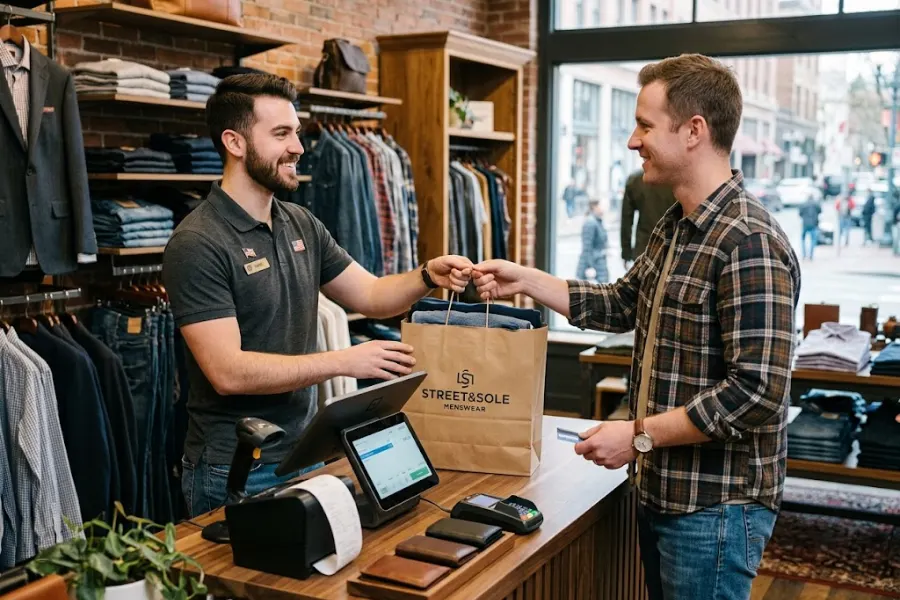
Your point of sale solutions act as the central nervous system of your entire operation. It is no longer just a digital cash register; it is a hub for inventory management, customer data, and sales analytics. Selecting a system that doesn’t align with your specific store model can lead to friction at checkout, inaccurate stock levels, and stalled growth. Whether you are running a boutique clothing shop or managing a high-volume multi-store franchise, the “right” system is the one that removes barriers between your products and your customers.
This guide from ConnectPOS gives you a hand to quickly identify which POS solution best fits your business and the factors to consider before making a decision.
Highlights
- Choosing the right point of sale solutions requires a strategic audit of your business size, sales channels, and inventory complexity to ensure long-term scalability.
- The “perfect fit” is found by matching specific operational pain points, such as omnichannel synchronization or appointment scheduling, with a system’s core functional strengths.
Key Factors to Consider Before Choosing a POS Solution
Before diving into specific brands, you must audit your internal needs. Not all point of sale solutions are created equal, and these five pillars often determine the “best” one:
- Business size and growth plans: Are you a solo entrepreneur or a growing enterprise? A simple tablet-based POS might suffice for a local kiosk, but if you plan to open three more locations in the next two years, you need a system that supports multi-store scaling without requiring a complete software overhaul later.
- Sales channels (in-store, online, mobile): The lines between physical and digital commerce have blurred. Modern point of sale solutions must offer real-time synchronization between your e-commerce platform (like Shopify or Magento) and your physical storefront to prevent overselling.
- Inventory complexity: A grocery store managing 10,000 SKUs with expiration dates needs vastly different features than a specialized service business. Look for systems that handle “matrix attributes” (size, color, material) if you are in fashion, or batch tracking if you deal with perishables.
- Budget and total cost of ownership: According to Grand View Research, the global POS market is expected to reach $181.47 billion by 2030, driven largely by the shift toward cloud-based software. When budgeting, consider not just the monthly subscription, but also transaction fees, hardware costs, and potential “hidden” fees for customer support or premium integrations.
- Ease of use and staff training: High turnover is a reality in retail. If your point of sale solutions require a week of training to master, you will lose valuable time and increase the risk of user error during peak hours.
Point of Sale Solutions by Store Model: A Quick Match Guide
Every business model has a unique “pain point.” Here is how to match your store type with the ideal features to secure long-term viability.
Single-Location Retail Stores
For a single-location owner, time is the most precious commodity. You need point of sale solutions that require zero IT expertise, offer low upfront costs, and provide clear, basic reporting to understand daily profit margins.
The Match: These stores thrive on “plug-and-play” systems. The goal is to get up and running in hours, not weeks.
Key Features:
- Built-in Payment Processing: Eliminates the need for third-party merchant contracts.
- Basic Loyalty Tools: Simple “buy 10, get 1 free” or email capture at checkout to fuel repeat business.
- Offline Mode: Guarantees you can still take payments if the shop’s Wi-Fi dips.
Multi-Store and Franchise Businesses
Managing two stores is three times harder than managing one. You face challenges in data fragmentation, inconsistent pricing, and “blind spots” in your stock levels. You need point of sale solutions that provide a “bird’s eye view” of the entire enterprise.
The Match: Scalable, cloud-based systems that allow for hierarchical management (e.g., a “Master” account that controls “Sub-store” accounts).
Key Features:
- Global Inventory Visibility: See exactly where every unit of stock is across the country.
- Centralized Product Management: Change a price or launch a promotion at Head Office and see it reflect across 50 stores instantly.
- Inter-Store Transfers: Logistical tools to move stock from a slow-moving location to a high-demand one.
Omnichannel Retailers
The modern customer doesn’t see “online” and “offline” as separate, they see one brand. Your biggest challenge is confirming that a sale on your website doesn’t result in a “ghost stock” error in your physical store.
The Match: High-level integration where the web store and the physical warehouse share the same “brain.”
Key Features:
- Real-time Synchronization: Stock levels update within seconds across Shopify, Magento, and your physical shelves.
- Unified Customer Profiles: A customer’s points earned online should be spendable in-store.
- Flexible Fulfillment: Support for “Buy Online, Pick Up In-Store” (BOPIS) and “Ship from Store.”
Specialty Stores (Fashion, Electronics, Grocery)
Generalist systems often fail specialty retailers. A grocery store needs to weigh produce; a fashion boutique needs to manage “Size/Color/Style” matrices; an electronics shop needs to track high-value serial numbers for theft prevention and warranties.
Furthermore, digital transformation is non-negotiable for this sector, as the global salon and spa management software market is projected to reach $1.35 billion by 2030, reflecting the massive shift toward automated client engagement.
The Match: Niche-specific point of sale solutions or highly modular platforms that allow for custom attribute tracking.
Key Features:
- Matrix Inventory: One product entry (e.g., “T-shirt”) with 15 variations of size and color.
- Serial Number & Warranty Tracking: Crucial for high-end electronics and repair shops.
- Unit of Measure (UoM) Support: Essential for selling by weight, length, or volume (common in grocery and hardware).
Service-Based Businesses (Salons, Spas, Repair Shops)
Unlike traditional retail where the product sits on a shelf, your “product” is time and expertise. Your biggest operational headaches are “no-shows,” overlapping bookings, and the disconnect between providing a service (like a haircut) and selling a physical product (like shampoo). You need point of sale solutions that treat a calendar slot with the same precision as an inventory SKU.
The Match: Hybrid systems that fuse a robust booking engine with a traditional retail checkout.
Key Features:
- Integrated Appointment Scheduling: Customers can book online 24/7, with slots automatically syncing to your POS terminal.
- Automated SMS/Email Reminders: Decrease no-shows by up to 30% by nudging customers before their appointment.
- Deposit & Cancellation Management: The ability to take partial payments upfront to secure a time slot.
- Commission Tracking: Automatically calculates how much each stylist or technician earned based on the services performed and products sold.
ConnectPOS: A Flexible Point of Sale Solution for Omnichannel and Multi-Store Retailers
For retailers operating in the complex omnichannel space, ConnectPOS stands out as a highly adaptable choice. Rather than forcing a business into a rigid box, it focuses on bridging the gap between digital storefronts and physical locations with a robust suite of point of sale solutions.
Key features:
- Unified Reward Points: Customers can earn points from an online purchase and redeem them at a physical kiosk, creating a seamless brand experience.
- Click-and-Collect (BOPIS): Efficiently manage “Buy Online, Pick Up In-Store” workflows with automated notifications for both staff and customers.
- Real-time Inventory Sync: Makes sure that your inventory remains 100% accurate across Magento, Shopify, or BigCommerce, eliminating the risk of overselling during high-traffic sales.
- Mobile POS (mPOS): Empower staff to check stock levels or process payments anywhere on the shop floor, removing the friction of a central checkout counter.
- Multi-Warehouse Tracking: View and manage stock across multiple warehouses and storefronts simultaneously to optimize fulfillment and logistics.
- Offline Mode: Continue selling even if the internet goes down; the system automatically syncs all transaction data once the connection is restored so you never miss a sale.
- Customizable API: Open integrations allow you to connect with advanced ERPs, CRMs, or accounting software like QuickBooks and Xero as your business complexity grows.
FAQs: Point of Sale Solutions
- Which point of sale solutions are best for multi-store retailers?
Cloud-based systems like ConnectPOS are ideal because they offer centralized inventory, staff permissions per location, and consolidated regional reporting.
- Are point of sale solutions suitable for small businesses?
Yes. Mobile or tablet-based systems offer low entry costs and professional-grade tracking while saving valuable counter space.
- Can I switch point of sale solutions as my business grows?
Yes, most systems allow CSV data exports. However, starting with a scalable solution saves the time and cost of retraining staff later.
Wrap Up
The answer to “Which Point of Sale Solution Fits Your Store Model?” depends on aligning your software’s capabilities with your specific operational friction. Single-store owners need simple, plug-and-play systems, while multi-store franchises require centralized, cloud-based management. Omnichannel retailers must prioritize real-time synchronization between e-commerce and physical inventory, and service-based models need integrated scheduling.
When auditing factors like business size, sales channels, and inventory complexity, you avoid common pitfalls. ConnectPOS offers the ultimate flexible solution, providing the omnichannel excellence and hardware versatility required to scale any modern retail model efficiently.
Ready to find your perfect match? Book a free demo with ConnectPOS today and transform your store’s efficiency!