As consumer expectations for faster and more convenient shopping continue to rise, retailers need efficient ways to reduce queues and improve the checkout experience. A modern self-checkout system helps businesses streamline transactions, minimize wait times, and enhance operational efficiency during peak hours. In this article, ConnectPOS explores how an efficient self-checkout system can support smoother store operations, optimize labor efficiency, and create a faster, more seamless customer experience.
Highlights
- Create intuitive, user-friendly self-checkout experiences to eliminate friction and reduce wait times, empowering shoppers with seamless autonomy.
- Implement ConnectPOS for real-time inventory sync and customizable workflows, ensuring robust operational efficiency and scalable growth for your retail business.
Understanding Self-Checkout System and Its Importance
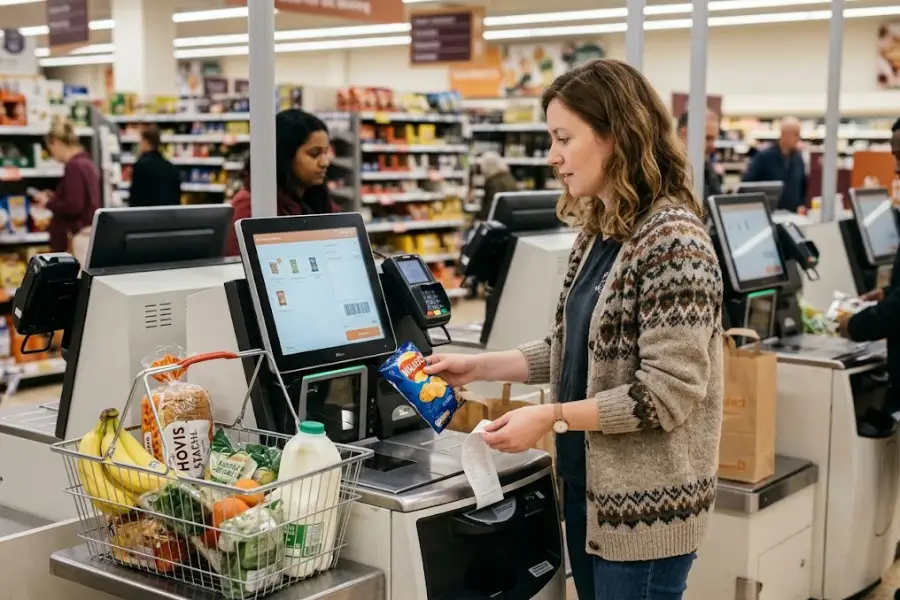
A self-checkout system refers to a technology-driven point-of-sale setup that allows customers to scan, pay for, and complete their purchases without direct assistance from a cashier. In today’s retail environment, it has become a critical tool for maintaining relevance and operational excellence.
Data backs the importance of this technology. A 2025 Commerce Experience Report by NCR Voyix found that approximately 77% of shoppers choose self-checkout specifically for faster service. Furthermore, research from the Payments Association finds that 91% of retailers report self-checkouts increase sales, largely because these systems enable stores to handle higher transaction volumes without the bottleneck of limited cashier availability.
Rather than simply following the latest industry trends, businesses that adopt retail self-checkout are proactively addressing labor shortages and streamlining the shopping process to satisfy the modern demand for speed and independence.
Key Elements of an Effective Self-checkout System
Creating a system that actually delights customers requires attention to detail. An automated checkout system must be intuitive, secure, and inclusive.
- User-Friendly Interface: The hallmark of a great system is simplicity. A self-service checkout technology should require minimal steps to complete a purchase. The UI should be uncluttered, using clear icons and large, responsive touch-screen elements that guide the user from “Scan” to “Pay” without confusion
- Reliable Barcode and Product Recognition: Accuracy is paramount. Advanced scanning hardware and AI-powered recognition ensure that products are identified correctly on the first attempt, minimizing the frustration of “unexpected item” errors that often plague older systems.
- Flexible Payment Options: A modern POS self-checkout integration must support diverse payment methods. Customers expect to pay via credit/debit cards, contactless NFC (Apple Pay, Google Pay), and even QR codes. Flexibility here is non-negotiable for a smooth transaction.
- Security and Loss Prevention: While automation increases throughput, it must be balanced with security. Modern systems utilize integrated cameras, weight-sensitive scales, and real-time software alerts to detect potential discrepancies, confirming that operational efficiency doesn’t come at the cost of shrinkage.
- Accessibility Features: Inclusivity is a design imperative. An effective system should cater to all customers by offering multi-language support, adjustable height for wheelchair access, and voice guidance for visually impaired users
Steps to Design a Self-checkout System That Enhances Customer Experience
Designing a successful self-checkout system requires a strategic blend of spatial psychology, technical precision, and user-centric logic. Success lies not in the hardware itself, but in the strategic re-engineering of the checkout experience to meet the modern demand for a seamless transition from aisle to exit.
Follow these detailed steps to make sure your implementation truly elevates the shopping experience.
Understand Customer Behavior and Store Layout
Before a single bolt is tightened, you must analyze the natural “current” of your store’s foot traffic. A self-checkout system should be positioned at a high-visibility vantage point typically near the primary exit, yet it must be carefully spaced to prevent “bottlenecking” where customers enter or browse.
Consider the psychology of choice: many retailers find success with a hybrid layout. When placing self-service kiosks directly adjacent to traditional manned registers, you provide a “safety net” for customers. This proximity allows shoppers to gauge queue lengths in real-time and choose the path of least resistance.
Additionally, guarantee there is ample “buffer space” around the kiosks so that customers with baskets or small carts don’t feel cramped or rushed by those waiting behind them.
Optimize the Checkout Workflow
In the world of retail self-checkout solutions, every additional screen or “click” is a potential point of abandonment. Should your goal be to create a “three-tap” philosophy: Can a customer identify their items, choose a payment method, and receive a receipt in the fewest steps possible?
Start by auditing and testing your software interface. Eliminate redundant prompts, such as aggressive upselling or lengthy post-purchase surveys during peak hours, which can frustrate a user in a hurry. The logical flow should be unmistakable: Scan → Bag → Pay → Receipt. Use “smart” defaults such as automatically selecting the most common payment type or skipping the bag-weight verification for known lightweight items to keep the momentum moving forward.
Ensure Speed and System Stability
Downtime is the ultimate enemy of retail automation.Customer trust in your technology is eroded the moment a frozen screen or lagging processor halts a transaction. . To prevent this, your POS self-checkout integration must be built on high-performance hardware capable of processing complex data locally and in the cloud simultaneously.
System stability also extends to the peripheral hardware. Ensure your barcode scanners are industrial-grade and capable of reading damaged labels or dim smartphone screens (for digital coupons). Even during the chaos of Black Friday or holiday rushes, a robust platform like ConnectPOS guarantees your software stays responsive, providing a 99.9% uptime that keeps both your lines moving and your customers satisfied.
Provide Clear Guidance and On-screen Assistance
Even the most tech-savvy shopper can be momentarily stumped by a new interface. To mitigate “checkout anxiety,” incorporate high-contrast visual cues and helpful animations. For example, if a customer needs to weigh a piece of produce, the screen should display a brief, silent video clip demonstrating exactly where to place the item.
UI prompts should be written in plain, actionable language (e.g., “Place item in the bagging area” instead of “Waiting for scale stabilization”).
Furthermore, ensure the “Call for Assistance” button is always visible but positioned so it isn’t triggered accidentally. This digital guidance acts as a silent concierge, walking the customer through the process without making them feel supervised.
Integrate Staff Support When Needed
The most successful automated checkout systems are those that empower humans rather than replacing them. Instead of cashiers, transition your team into “Service Ambassadors.” These staff members should be stationed within the self-checkout zone, equipped with mobile devices or tablets that receive instant alerts when a kiosk requires intervention.
A premium experience relies on the “secret sauce” of immediate human support; whether it’s clearing a weight error or assisting with a barcode, rapid intervention ensures technology never becomes a barrier. When a staff member can resolve an issue in seconds before the customer even feels the need to ask for help, you transform a potential moment of frustration into a high-touch service win.
How ConnectPOS Supports Self-checkout System Implementation
When looking for a solution that combines power with simplicity, ConnectPOS stands out as a leading choice for retailers. It is designed to unify your online and offline operations, making it an ideal partner for implementing a robust self-checkout experience.
ConnectPOS provides several critical advantages:
- Seamless POS Integration: Instant synchronization between inventory and kiosks for real-time pricing and product updates.
- Live Inventory Sync: Eliminates “out-of-stock” errors by unifying stock levels across all digital and physical sales channels.
- Omnichannel Agility: Delivers a consistent brand experience across permanent storefronts, pop-up shops, and enterprise chains.
- Customizable Workflows: Tailor the interface for anything from high-speed “scan-and-go” to detailed, step-by-step transactions.
- Advanced Security & Alerts: Proactively manages shrinkage with instant notifications for weight discrepancies or age-restricted items.
- Real-Time Analytics: Tracks kiosk performance and peak-hour traffic to optimize staffing and hardware placement.
Rather than simply buying software, you are empowering your business with a robust platform that bridges the gap between operational ease and premium customer service.
FAQs: Self-Checkout System
- Are self-checkout systems secure?
Yes. Modern systems are equipped with robust security measures, including integrated cameras, weight sensors, and software-based fraud detection.
- What industries benefit most from self-checkout technology?
While retail and grocery are the primary users, sectors like hospitality, pharmacy, and entertainment are rapidly adopting the technology to handle high-traffic volumes and improve operational throughput.
- Can a self-checkout system integrate with existing POS software?
Absolutely. Modern solutions like ConnectPOS are built with integration in mind. They can seamlessly sync with your current inventory and sales databases, often through flexible APIs, to ensure a unified business management experience.
Wrap Up
The transition to a self-checkout system is a definitive step toward modernizing your retail business. By focusing on an intuitive design, maintaining robust security, and selecting a reliable partner, you can significantly enhance your customer experience while driving operational efficiency.
The future of retail is autonomous, fast, and customer-centric. Don’t let your store fall behind. Ready to modernize your checkout? Book a demo to learn how our seamless integration helps you implement a world-class self-checkout system and boost operational efficiency instantly.
►►► Optimal solution set for businesses: Shopify POS, Magento POS, BigCommerce POS, WooCommerce POS, NetSuite POS, E-Commerce POS