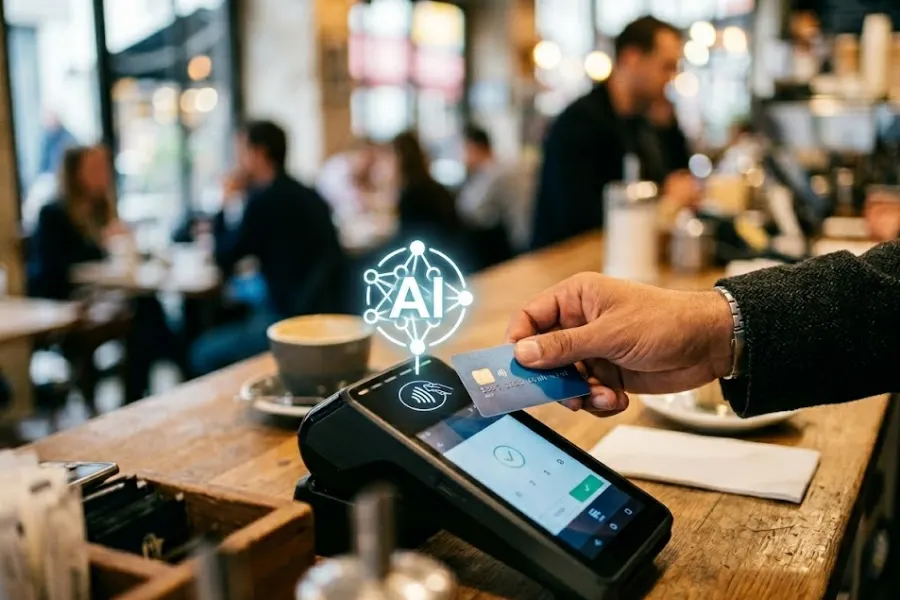
As consumer demand for faster, more autonomous shopping experiences grows, retailers must address the inefficiencies caused by outdated checkout systems. Long lines, overwhelmed staff, and lost sales during busy periods highlight the need for smarter retail technology. AI powered POS systems and intelligent platforms offer an effective solution by reducing friction at checkout while balancing customer independence with operational control.
This ConnectPOS guide explains how retailers can strategically implement these advanced tools to improve efficiency, streamline operations, and adapt to evolving consumer expectations.
Highlights
- AI powered POS systems transform traditional checkout operations into intelligent business hubs by using machine learning, predictive analytics, and automation to optimize performance.
- Businesses adopting AI powered POS systems gain measurable operational and financial advantages, including improved productivity, smarter inventory control, dynamic pricing, and increased average order value.
What are AI Powered POS Systems?
At its core, AI powered POS systems are the point-of-sale platform enhanced with artificial intelligence and machine learning capabilities. While traditional systems function as passive ledgers recording transactions after they happen, AI-driven solutions are proactive. They constantly analyze incoming data streams to provide actionable intelligence in real-time.
These systems differ from legacy hardware in their ability to “learn.” They synthesize vast amounts of historical data, customer behavior patterns, and inventory fluctuations to make autonomous decisions.
Whether it’s flagging a potential fraud case or suggesting a discount to increase the average transaction value, the AI acts as a 24/7 business consultant, moving your operation from a state of “recording” to a state of “predicting.”
Key Features of AI Powered POS Systems
To truly understand why these systems are revolutionary, we must look at the specific capabilities they bring to the retail floor. When automating complex manual tasks, these features allow business owners to focus on strategy rather than spreadsheets.
- Predictive Sales Analytics: AI powered POS systems can forecast future sales trends by analyzing seasonality, historical performance, and even local weather patterns. This allows you to plan staff shifts and promotional calendars with mathematical precision.
- Smart Inventory Management: Forget manual counts and stockout surprises. Smart inventory features automatically track stock levels and predict demand, triggering reorders before items hit zero. This guarantees you maintain the perfect balance of supply and demand.
- Personalized Customer Experience: When a customer interacts with your brand, the system recognizes their preferences. The POS enhances customer retention by creating personalized shopping journeys through intelligent product recommendations and automated loyalty reward management.
- Fraud Detection and Risk Monitoring: AI algorithms monitor transactions in real-time. When identifying anomalous patterns such as irregular refund requests or suspicious discount usage, the system protects your bottom line against internal and external threats before significant damage occurs.
- Automated Reporting and Insights: Instead of waiting for month-end reports, you get immediate snapshots of your business performance. AI organizes complex data into clear, intuitive dashboards, highlighting your best-performing products and sales channels instantly.
Benefits of Using AI Powered POS Systems
Transitioning to intelligent retail solutions offers a clear path toward operational excellence and sustainable growth. When removing guesswork and manual oversight, these platforms allow businesses to operate with a high degree of confidence and agility.
- Increased Average Order Value (AOV): AI-driven suggestion engines prompt staff or self-service kiosks to offer context-aware upsells (e.g., suggesting a specific wine pairing for a steak order), consistently pushing higher margins.
- Dynamic Pricing Strategy: When analyzing competitor pricing and real-time demand, the AI can suggest optimal pricing adjustments to maximize revenue during peak hours and maintain competitiveness during lulls.
- Potential Annual Value of AI in Retail: According to research by McKinsey & Company, the potential annual value of AI in retail is estimated to be between $400 billion and $800 billion, driven primarily by improvements in supply chain management and customer service.
- Automated Staff Scheduling: The system analyzes traffic patterns to recommend optimal staffing levels, ensuring you aren’t paying for excess labor during slow periods while guaranteeing adequate coverage for rushes.
- Loss Prevention: AI continuously audits transactions for “sweethearting” or irregular refunds, creating a proactive barrier against internal shrinkage.
- Predictive Maintenance: The system can monitor equipment (like digital kiosks or kitchen hardware) for performance degradation, alerting you to potential failures before they shut down your operations.
- Hyper-Personalization: Every interaction is data-informed. The system recalls past preferences, allowing for a “VIP” experience even for casual shoppers, which is a proven driver of repeat business.
- Reduced Checkout Friction: AI transforms checkout into a faster and more effortless experience by automating promotions and simplifying the payment process, reducing the time customers spend waiting at the register.
- Consistent Service: With standardized AI-driven workflows, the quality of service remains high across all shifts and locations, regardless of individual employee experience levels.
- Increase in Operational Productivity: Studies indicate that retailers successfully implementing AI-enabled operations report up to a 15–20% increase in operational productivity, which helps the investment pay for itself through saved labor hours and decreased shrinkage.
How AI Powered POS Systems Are Transforming Different Industries
The adaptability of AI means that its impact is felt uniquely across various sectors, confirming that every business type, from boutiques to global chains, finds value in the technology.
Retail Stores
In the highly competitive retail sector, success is determined by how well a brand knows its customers and how quickly it can react to market shifts. AI powered POS systems enable three critical functions: dynamic pricing, demand forecasting, and hyper-personalized marketing.
Instead of relying on gut feelings, retailers can now optimize product placement and promotional timing based on empirical, data-driven insights. This shift leads directly to increased sales velocity and higher customer satisfaction scores.
A boutique retailer uses an AI-powered POS to analyze seasonal sales of accessories. The system identifies that customers buying scarves in October often purchase matching gloves in November. The AI automatically triggers a targeted email promotion for the gloves to those specific customers in early November, leading to a 15% increase in conversion.
Restaurants and Hospitality
For the food and beverage industry, efficiency is measured in seconds. AI powered POS systems streamline order management, significantly decrease wait times, and virtually eliminate the human error associated with complex orders.
Beyond the kitchen, these systems analyze guest preferences to recommend high-margin menu items and optimize pricing strategies based on peak demand periods.
A fast-casual restaurant chain implements AI-driven drive-thru menus. Based on the time of day, current local weather (hot vs. cold), and inventory levels (pushing items with high stock), the menu updates dynamically. This automation has allowed the chain to speed up drive-thru service by 20% and significantly minimize food waste by steering customers toward items in high supply.
Grocery Stores and Supermarkets
In the grocery sector, margins are thin and the cost of waste is high. Here, AI serves as an essential tool for inventory freshness. When predicting the shelf-life demand of perishables with high accuracy, these systems ensure that inventory is ordered and sold within optimal timeframes. This decreases the environmental impact of food waste while protecting the store’s bottom line.
A local grocery store uses predictive AI to manage the shelf-life of perishables. When correlating sales velocity with historical spoilage rates, the system alerts the manager to discount specific items (like bakery goods or produce) when they are at risk of expiration, turning potential waste into “clearance” revenue.
Multi-Location Businesses
Scaling a business is a complex endeavor fraught with data silos and operational inconsistencies. AI-powered POS systems simplify this by providing a “single source of truth” for all locations.
Managers no longer have to manually aggregate reports from ten different stores; instead, a centralized system allows them to compare performance, standardize protocols, and push updates across the entire network in seconds.
A franchise owner with 10 locations uses a centralized AI-POS to push menu or pricing changes instantly. Furthermore, the system provides a comparative dashboard that ranks store performance.
If one store’s “ticket closure time” is consistently slower than the others, the AI flags this for management investigation, revealing that the slower store requires additional training or a layout adjustment.
Key Technologies Behind AI Powered POS Systems
You don’t need a computer science degree to appreciate the tech, but understanding the basics helps you utilize your POS better.
- Machine Learning Algorithms: These are the brains of the operation. They process historical sales, customer habits, and inventory data to identify trends and make future predictions.
- Computer Vision: Increasingly used in self-checkout kiosks and security, this allows the POS to identify products instantly and detect suspicious behavior at the checkout counter.
- Natural Language Processing (NLP): This powers the voice-activated features and search capabilities, allowing staff to ask the POS for data (e.g., “Show me sales for the last week”) without navigating complex menus.
ConnectPOS: A Modern POS Solution for AI-Driven Retail
ConnectPOS serves as a strategic cornerstone for businesses thriving in a digital-first world. Far more than a traditional checkout tool, it acts as a future-proof partner designed to bridge the gap between physical retail and e-commerce.
ConnectPOS AI helps retailers stay competitive by combining AI-powered intelligence with a seamless all-in-one platform, allowing businesses to replace manual tasks with faster, smarter, and more strategic decision-making.
Key Features
- Omnichannel Synchronization: Effortlessly bridge the divide between your physical storefront and online sales, ensuring real-time inventory and data accuracy across all channels.
- End-to-End Scalability: Whether you are operating a single boutique or scaling a massive, multi-location retail chain, the system adapts dynamically to your business’s growth.
- Unified Dashboard: Manage complex operations including inventory tracking, loyalty programs, and financial reporting from a single, intuitive interface.
- AI-Enhanced Insights: Leverage built-in AI analytics to transform raw transaction data into actionable strategies for inventory management, customer retention, and revenue growth.
- Seamless Offline Mode: Retail doesn’t stop when the internet does. ConnectPOS features a robust offline mode that allows you to continue processing sales and managing customers during connectivity drops. Once the connection is restored, all data is automatically synchronized across the cloud, ensuring no transaction is ever lost.
- Customizable Loyalty & Reward Engines: AI helps identify high-value shopping patterns, and ConnectPOS allows you to act on them. Create personalized reward tiers and targeted promotions directly through the POS interface to increase customer lifetime value and drive repeat foot traffic.
FAQs: AI Powered POS Systems
- Are AI powered pos systems suitable for small businesses?
Yes, many AI-powered POS systems are scalable and affordable, making them suitable for small businesses. They help streamline operations and provide valuable insights without requiring extensive resources.
- How secure are AI powered POS systems?
AI-powered POS systems are highly secure, using advanced encryption and fraud detection algorithms to protect transactions and sensitive data.
- Can AI POS systems integrate with eCommerce platforms?
Most modern AI-powered POS systems offer seamless integration with eCommerce platforms, enabling businesses to manage online and offline sales from a single system.
Conclusion
In conclusion, AI-powered POS systems are transforming modern business operations by combining intelligent automation, predictive insights, and real-time data analysis into a single powerful solution. From streamlining workflows and improving decision-making to enhancing customer experiences and driving higher revenue, these advanced systems are helping businesses stay agile in an increasingly competitive market.
Ready to future-proof your business with smarter retail technology? ConnectPOS provides a modern, scalable POS solution designed to help businesses harness the full potential of AI-powered operations. Contact us today and take the next step toward a more efficient, data-driven future.
►►► Optimal solution set for businesses: Shopify POS, Magento POS, BigCommerce POS, WooCommerce POS, NetSuite POS, E-Commerce POS