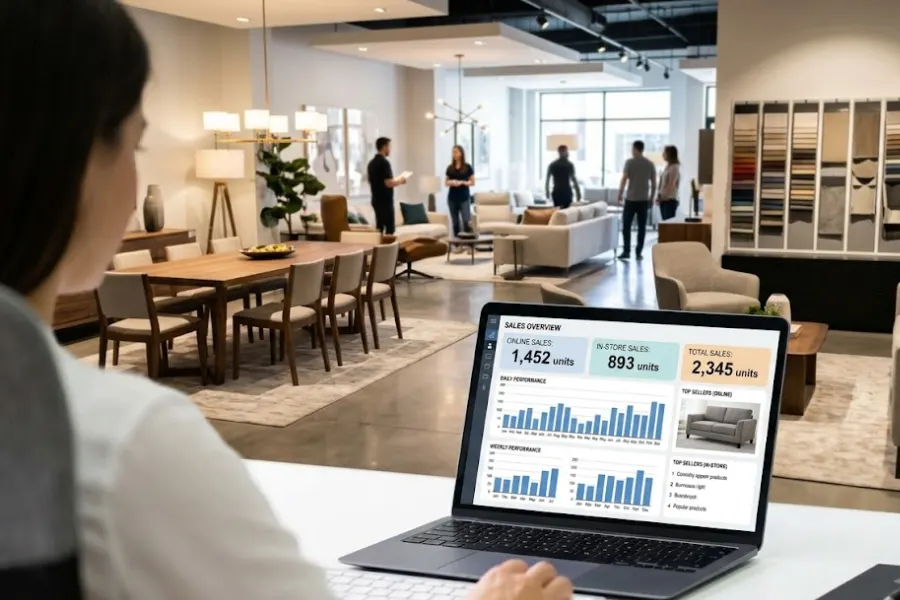
Enterprise retail now demands more than fast transactions. Modern POS systems act as centralized platforms that connect inventory, sales, customer data, and operations across physical stores and digital channels in real time. For large retailers, the right POS supports unified commerce, improves visibility, and helps maintain operational consistency across regions. Choosing the wrong system can create inefficiencies, limit scalability, and slow decision-making, while a well-aligned platform strengthens control and customer experience at scale. In this article, ConnectPOS explores five enterprise retail POS systems in 2026 and examines how each solution supports complex retail operations and long-term business growth.
Highlights
- Enterprise retail POS has shifted from a checkout role to a control layer that connects inventory, sales, and customer data across all channels, shaping how large retailers manage operations and maintain consistency at scale.
- Growth in 2026 is driven by unified commerce, real-time data, and AI-driven insights, allowing retailers to align in-store and online activity while improving visibility, planning, and operational control.
- Choosing the right POS depends on scalability, ERP integration, and omnichannel capability, with platforms like ConnectPOS, Shopify POS, Lightspeed, Square, and NetSuite addressing different enterprise retail needs.
How Enterprise Retail POS Systems Drive Retail Growth in 2026
Enterprise retail POS systems have moved beyond transaction handling into platforms that connect sales channels, operational data, and decision-making processes. In 2026, growth is shaped by how well retailers align in-store activity with digital channels, maintain visibility across inventory and customer behavior, and support expansion without losing control over daily operations.
Unified Commerce: Connecting Online and Offline Sales
The global unified commerce market is projected to reach USD 8,500 billion by 2034, reflecting the growing demand for connected retail operations.
Enterprise POS systems connect physical stores with eCommerce platforms, supporting transactions, inventory, and customer data to flow within a single environment. This alignment reduces fragmentation between channels and supports consistent product availability, pricing, and order handling across all touchpoints.
Customers interact with brands across channels, and unified commerce enables retailers to respond with consistent service. Orders placed online can be fulfilled in-store, returned across locations, or tracked through a single system, creating a more coordinated operational structure.
AI & Data Analytics in Enterprise POS
64% of organizations report AI contributing to innovation, reflecting its role in improving planning accuracy and operational responsiveness rather than relying only on historical reports. AI within enterprise POS systems processes transaction data, customer behavior, and inventory movement to support more informed operational decisions. Instead of relying on historical reports alone, retailers gain access to real-time insights that reflect current demand patterns.
Data analytics supports demand forecasting by identifying trends across locations and product categories. This helps retailers adjust stock allocation, pricing strategies, and promotional activities based on actual performance data rather than assumptions.
AI also contributes to risk control and operational monitoring. It can detect irregular transaction patterns, highlight anomalies in inventory movement, and support workforce planning based on store traffic and sales volume.
Scalability and Integration with ERP Ecosystems
Enterprise retail POS systems support business expansion by maintaining consistent operations across growing store networks. As new locations are added, the system extends existing workflows, enabling retailers to scale without rebuilding their operational structure.
Integration with ERP systems connects POS data with finance, supply chain, and procurement processes. This creates a unified data environment where sales activity directly informs inventory planning, purchasing decisions, and financial reporting.
As operations grow, centralized control becomes more important. Enterprise POS systems allow head office teams to monitor performance, manage stock distribution, and maintain standardized processes across all locations, supporting stable growth at scale.
Essential Criteria for Choosing an Enterprise Retail POS
Selecting an enterprise retail POS system involves evaluating how well the platform supports large-scale operations, data consistency, and long-term growth. The system must align with complex retail workflows, connect multiple sales channels, and maintain control over inventory, transactions, and reporting across locations. A strong POS foundation enables retailers to manage expansion while keeping operational visibility and coordination intact.
Key criteria
- Unified commerce capability: Ability to connect in-store and online sales into one system, keeping inventory, orders, and customer data aligned across all channels.
- Real-time data visibility: Provides access to up-to-date information on sales, stock levels, and customer activity, supporting timely operational decisions.
- Scalability across locations: Supports expansion into new stores without disrupting existing workflows, while maintaining consistent processes and data structure.
- Integration with ERP and external systems: Connects POS data with finance, supply chain, and customer management systems to maintain a unified operational environment.
- Inventory control and accuracy: Tracks stock movement across locations with clear visibility into availability, transfers, and replenishment needs.
- Reporting and analytics: Generates structured insights on performance, demand patterns, and operational trends to support business planning.
- Security and access control: Manages user permissions and transaction records to maintain accountability and protect sensitive business data.
- Omnichannel fulfillment support: Handles order fulfillment across different channels, including in-store pickup, delivery, and cross-location returns.
5 Leading Enterprise Retail POS Systems in the Market
These five enterprise retail POS systems represent different approaches to managing large-scale retail operations, from flexible cloud-based platforms to fully integrated ERP solutions.
While all of them support core functions such as payments, inventory, and reporting, they vary significantly in terms of scalability, customization, and omnichannel capabilities. Choosing the right system depends on how well it aligns with a retailer’s operational complexity, growth strategy, and need for unified data across multiple sales channels.
ConnectPOS
ConnectPOS is a cloud-based enterprise retail POS platform designed for omnichannel and multi-location businesses. It connects in-store and online operations through real-time synchronization of inventory, orders, and customer data, helping retailers maintain consistent control across sales channels. The system integrates with major eCommerce platforms such as Shopify, Magento, and WooCommerce, making it suitable for businesses that operate both physical stores and digital storefronts.
Features
- Omnichannel integration: Connects POS with eCommerce platforms, keeping inventory, orders, and customer data aligned across online and offline channels.
- Real-time data synchronization: Updates sales, stock levels, and customer information continuously across all locations, supporting consistent operational visibility.
- Multi-store and multi-warehouse control
Supports centralized management of inventory, transfers, and performance tracking across multiple stores and warehouses. - Offline mode operation: Enables transactions to continue without an internet connection, with automatic data sync once connectivity is restored.
- Flexible payment and checkout options: Supports various payment methods, split payments, and customizable checkout flows for different retail scenarios.
- Inventory and order management: Tracks product movement, manages stock across channels, and supports order processing within a unified system.
- Reporting and analytics: Provides valuable insights into sales performance, customer behavior, and inventory trends to support operational planning with ConnectPOS POS reporting and analytics.
- Custom integrations and scalability: Supports API integrations and tailored configurations, allowing businesses to adapt the system to specific operational requirements.
Pricing
ConnectPOS follows a subscription model starting from around $39 per register per month, with higher tiers ranging up to $99 depending on features. Enterprise pricing is provided based on business scale, number of locations, and customization requirements.
Square POS
Square POS is widely used across small businesses and growing retail chains. It combines payment processing, inventory management, customer data, and reporting within one system, making it accessible for businesses transitioning from basic setups to more connected operations. While originally built for smaller merchants, Square has expanded its capabilities with higher-tier plans and enterprise options to support multi-location retail environments.
Features
- Integrated payment processing: Supports card, contactless, and digital wallet payments directly within the POS, removing the need for third-party processors.
- Inventory and catalog management: Tracks stock levels, manages SKUs, and supports bulk item imports, helping retailers maintain product data across locations.
- Sales reporting and analytics: Provides real-time sales data, performance reports, and insights into product trends and customer activity.
- Omnichannel support: Connects in-store and online sales, businesses can manage orders, payments, and fulfillment within one system.
- Customer management tools: Stores customer profiles, purchase history, and supports loyalty and marketing features for repeat engagement.
- Multi-location management: Enables retailers to manage multiple stores with shared data, including inventory visibility and cross-location operations.
Pricing
Square POS provides a free base plan with transaction fees (around 2.6% + 15¢ per in-person payment). Paid plans start at about $49 per month per location, with higher tiers up to $149 per month. Enterprise pricing is available on request for larger retailers with more complex requirements.
Shopify POS
Shopify POS is an enterprise retail POS system built to connect in-store and online sales within a single platform. It is widely adopted by retailers that operate across eCommerce and physical stores, allowing inventory, customer data, and transactions to stay aligned across channels. The system is particularly strong in omnichannel retail, supporting businesses that require consistent operations between digital storefronts and brick-and-mortar locations.
Features
- Omnichannel commerce integration: Connects online and offline sales, retailers can manage orders, inventory, and customer data within one system.
- Real-time inventory synchronization: Updates stock levels across locations and channels, helping prevent overselling and improving inventory visibility.
- Multi-location management: Supports centralized control across stores, with the ability to handle inventory, reporting, and staff activity across large retail networks.
- Customer profiles and loyalty insights: Stores purchase history and customer data, supporting personalized engagement and retention strategies.
- Staff management and access control: Provides role-based permissions and performance tracking, improving control over store operations
- Retail analytics and reporting: Generates real-time reports on sales, inventory, and store performance to support operational decisions.
- Flexible hardware and mobile POS: Runs on tablets, smartphones, and dedicated hardware, allowing retailers to handle transactions at the counter or on the shop floor.
Pricing
Shopify POS is included in all Shopify plans starting at $39/month, with advanced POS Pro features available at an additional $89/month per location. Higher-tier plans such as Advanced ($399/month) and Plus (from $2,300/month) provide deeper reporting, lower transaction fees, and broader operational capabilities for large-scale retail.
Lightspeed Retail
Lightspeed Retail is designed for retailers with complex inventory structures and multi-location operations. It is commonly used by businesses that manage large product catalogs or require deeper control over stock, purchasing, and reporting. The platform stands out for its inventory depth and customization capabilities, making it suitable for established retailers rather than small businesses with simple workflows.
Features
- Advanced inventory management: Supports product variants, bundles, serialized items, and custom reorder points, allowing detailed tracking across large SKU catalogs.
- Multi-location and centralized control: Manages inventory, sales, and purchasing across multiple stores with unified visibility and stock coordination.
- Purchase order and supplier management: Handles vendor catalogs, purchase orders, and stock replenishment workflows within the same system.
- Built-in eCommerce integration: Connects in-store operations with online sales, enabling synchronized inventory and order management across channels.
- Reporting and analytics: Provides detailed sales, inventory, and staff performance reports to support operational planning.
- App marketplace and integrations: Connects with accounting, marketing, payroll, and other business systems through a wide integration ecosystem.
- Customer support and account management: Includes 24/7 chat support and dedicated account management for business users.
Pricing
Lightspeed Retail pricing starts at around $109/month for the Basic plan, $179/month for Core, and $339/month for Plus, with lower rates available on annual billing. Transaction fees typically range around 2.6% + $0.10 for in-person payments.
NetSuite
NetSuite POS, delivered through SuiteCommerce InStore, operates as part of the broader Oracle NetSuite ecosystem rather than a standalone system. Transactions, inventory, customer data, and financial records are handled within the same platform, allowing retailers to maintain a single source of truth across store operations and back-office processes. This architecture is commonly adopted by enterprise retailers that require tight alignment between POS activity and ERP data across large, multi-location environments.
Features
- Native ERP integration: POS transactions are recorded directly in NetSuite, aligning sales, inventory, and accounting data without external syncing or middleware.
- Real-time inventory visibility: Inventory updates instantly across stores, warehouses, and online channels, supporting accurate stock availability and cross-location fulfillment.
- Unified customer data: Maintains a single customer record across channels, assisting store staff to access purchase history and customer information during transactions.
- Consistent pricing and tax logic: Pricing rules, promotions, and tax calculations are controlled centrally within NetSuite, reducing inconsistencies between channels.
- Omnichannel transaction support: Handles sales, returns, exchanges, and order fulfillment within the same system, maintaining consistency across in-store and online operations.
- Centralized reporting and financial alignment: Sales data feeds directly into financial reporting, reducing reconciliation gaps and improving visibility into business performance.
- Endless aisle capability: Store staff can access inventory across locations and fulfill orders even when items are not available in-store.
Pricing
NetSuite enterprise retail POS pricing is typically customized based on business size, modules, and implementation scope. Estimated costs range from around $30,000 to $60,000 per year, with additional onboarding and customization fees depending on system complexity and deployment scale.
FAQs About Enterprise Retail POS
How do I choose the right enterprise POS system?
To choose the right POS, evaluate your business size, number of locations, inventory complexity, and omnichannel requirements. Also consider integration with ERP or CRM systems, ease of use, and total cost of ownership to guarantee long-term scalability and operational efficiency.
What features should an enterprise POS include?
An enterprise POS should provide real-time inventory tracking, centralized multi-store management, omnichannel selling, advanced analytics, and built-in CRM tools. Integration with ERP platforms and cloud-based deployment are also essential for scalability and unified business operations.
What is the difference between SMB and enterprise POS systems?
SMB POS systems are designed for small retailers with basic needs, providing limited customization and integrations. Enterprise POS systems, in contrast, support high transaction volumes, multi-location management, advanced reporting, and deep integrations with systems like ERP and supply chain platforms.
Are cloud-based POS systems better for enterprises?
Yes, cloud-based POS systems are preferred for enterprise retail because they provide real-time data access, centralized control across all locations, and easier scalability. They also reduce upfront infrastructure costs and support smooth updates and integrations.
Conclusion
Choosing an enterprise retail POS system is a strategic decision that shapes how a retail organization operates, adapts, and grows over time. Each platform discussed reflects a different approach to handling scale, integration, and data management. The right choice depends on how well the system aligns with existing infrastructure, operational complexity, and long-term direction.
Retailers that treat POS as a core component of their technology ecosystem gain clearer visibility across channels and stronger control over execution at store level and beyond. This creates a foundation for consistent customer experiences and more informed business decisions.
For organizations seeking a POS platform built around omnichannel retail and enterprise requirements, ConnectPOS provides a solution designed to support complex operations and future expansion. Contact us to evaluate how it can fit into your retail strategy.