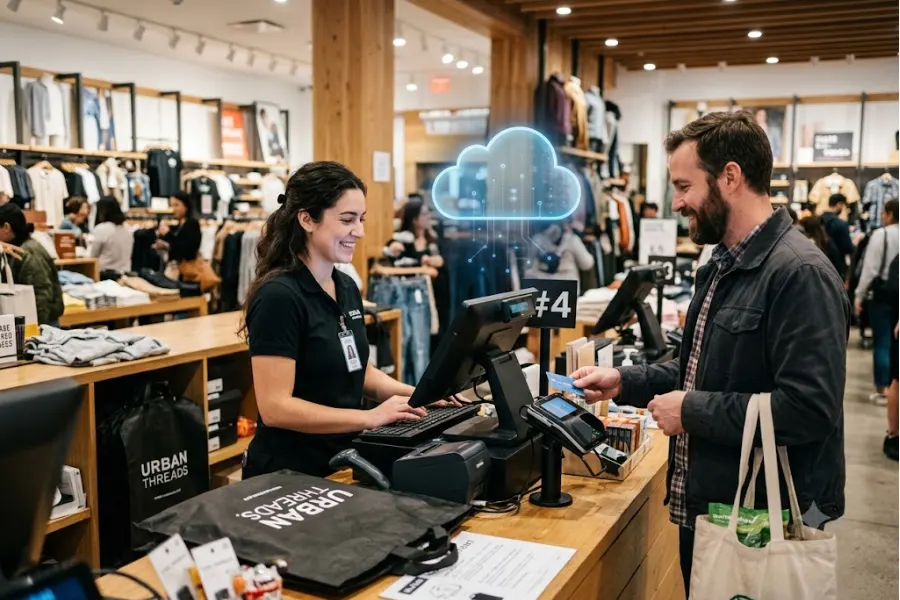
Cloud-based enterprise POS systems vs. on-premise solutions sit at the center of a key decision for modern brands. Your POS now integrates inventory, CRM, multi-store reporting, and omnichannel sales into a single centralized platform, so the deployment model shapes everything from daily operations to long-term growth. In this guide from ConnectPOS, we’ll look into more details on how both models compare in real-world enterprise scenarios, where standard POS setups usually fall short, and the practical factors that matter most when you’re choosing a system for scale.
Highlights
- Cloud POS offers superior agility, scalability, and omnichannel integration, making it ideal for growing, multi-store enterprises.
- On-premise POS provides total infrastructure control and offline reliability – suited for specialized, high-security, or limited-connectivity environments.
Cloud-based POS Systems: The Modern Solution
Cloud-based enterprise POS systems rely on internet-based infrastructure rather than local, physical servers. In this model, the software and your business data reside on remote, secure servers managed by the POS provider. As modern retail shifts toward digital-first strategies, cloud adoption has accelerated rapidly, enabling brands to pivot quickly to changing consumer demands.
Key Features
- Real-time data synchronization: Updates inventory, pricing, and sales data across all channels instantly.
- Remote access: Monitor KPIs and manage store settings from any location.
- Automatic updates: Software improvements and security patches are pushed remotely by the vendor.
- Omnichannel integration: Seamless connection between brick-and-mortar and e-commerce platforms.
- Multi-store inventory visibility: View stock levels across every warehouse and store in real-time.
- Subscription-based pricing: Predictable monthly or annual operating expenses (OpEx).
Pros and Cons
- Pros: Lower upfront capital investment, rapid multi-site deployment, effortless scalability, and reduced reliance on specialized on-site IT staff.
- Cons: Total reliance on a stable internet connection; potential for monthly recurring costs to exceed long-term license fees; data ownership remains subject to the vendor’s cloud security protocols.
On-Premise POS Systems: The Traditional Solution
On-premise POS solutions involve hosting software and databases on local hardware installed physically within your business premises. You retain full control over the infrastructure, security, and maintenance. Many large enterprises in legacy-heavy industries, such as heavy manufacturing or high-security government facilities, still favor this model due to its independence from external connectivity.
Key Features
- Local data storage: Data is kept on your internal network, allowing for total administrative control.
- Full infrastructure control: You dictate how the hardware and software are configured.
- Offline-first operation: The system remains fully functional even if your internet connection fails.
- Advanced customization: Easier to build bespoke, deep-level modifications into the system’s code.
Pros and Cons
- Pros: Superior control over proprietary data; zero internet dependency; no recurring subscription payments; customizable to unique, non-standard business workflows.
- Cons: Significant upfront hardware/licensing investment; costly manual maintenance; requires a dedicated internal IT team; difficult to scale to new geographic locations.
Cloud-based Enterprise POS Systems vs On-premise Solutions: Key Differences
Choosing between cloud and on-premise deployment requires evaluating how each model affects operational efficiency, costs, security, scalability, and long-term business growth.
Deployment and Accessibility
The gap between cloud and on-premise systems largely comes down to how you interact with your data. Cloud systems are accessible via a web browser or lightweight app, meaning you can check store performance from your home office.
In contrast, on-premise systems are tethered to the physical location of the server, often requiring complex VPNs for remote access, which introduces security and speed overhead.
Initial Investment vs Long-term Costs
Cloud-based models shift costs from Capital Expenditure (CapEx) to Operating Expenditure (OpEx), allowing for a pay-as-you-go approach.
On-premise systems require a large upfront purchase of servers, terminal licenses, and professional installation services. Notably, when analyzing Total Cost of Ownership (TCO), cloud-based systems are often found to be 20-30% more cost-effective over a five-year lifecycle due to reduced IT staffing requirements.
Maintenance and Software Updates
With cloud-based POS, maintenance is the vendor’s responsibility. Security patches and feature updates happen in the background without needing to pause your operations.
With on-premise systems, your IT team must manually test and deploy updates across all terminals. According to industry studies on retail operational efficiency, businesses using cloud-based POS can deploy new features 40% faster than those tied to legacy hardware.
Scalability and Business Expansion
Cloud-based POS systems provide “elastic” scalability. As your enterprise grows, adding a new store is often as simple as adding a new user seat and configuring a printer, a process that can be completed in minutes.
On-premise systems are inherently rigid; expanding requires purchasing additional server capacity, shipping hardware to the new location, and scheduling physical installation, which can delay store openings by weeks.
Security and Data Ownership
Security is a primary concern for any enterprise.
Cloud systems utilize sophisticated encryption and centralized security protocols that are updated instantly, whereas on-premise security relies entirely on your internal IT team’s ability to stay ahead of evolving cyber threats.
On-premise solutions offer the “illusion of security” by keeping data locally; they often lack the robust, 24/7 monitoring and automated threat detection offered by enterprise-grade cloud providers.
Internet Dependency
Most modern cloud-based enterprise systems now include “hybrid-cloud” capabilities, which allow registers to continue processing transactions offline and sync data once the connection is restored, bridging the gap between reliability and convenience.
Internet reliance is the primary differentiator for on-premise advocates. On-premise POS solutions excel in environments with poor connectivity, as they function entirely offline.
Speed and System Performance
Local processing on on-premise servers can offer millisecond response times because the data is on the same network. However, cloud systems have closed this gap with high-speed CDNs and optimized data caching.
For most retailers, the difference is negligible, but for high-volume environments with hundreds of transactions per minute per terminal, local processing can sometimes offer a slight performance advantage.
Integration with Third-party Tools
Modern enterprise retail relies on a tech stack that includes CRM, ERP, and loyalty programs.
Cloud-based POS systems typically offer open APIs, making it simple to “plug and play” with popular third-party software.
On-premise systems often require custom-built middleware or complex, expensive connectors to achieve the same level of integration, which can create significant technical debt.
Compliance and Regulatory Considerations
Enterprises in highly regulated industries (e.g., those handling sensitive customer financial data) often face strict compliance mandates.
While cloud providers now offer “compliance-as-a-service” with pre-audited environments, some enterprises prefer the “total control” of on-premise systems to meet internal data sovereignty policies. However, this places the burden of audit maintenance and compliance reporting entirely on your shoulders.
Which One Should You Choose?
Are you wondering about choosing a cloud-based enterprise POS systems vs. on-premise solutions? Cloud solutions are designed for the modern enterprise that values speed and data fluidity. If you are operating multiple stores, you require real-time visibility into your stock and sales, making cloud the clear choice for maintaining consistency.
- You operate multiple stores: Centralized management is crucial for consistency.
- You prioritize agility: You need to open new stores quickly.
- You want omnichannel capabilities: Integration with Shopify, Magento, or other e-commerce platforms is vital.
On-premise solutions are best suited for enterprises that prioritize total infrastructure control over software flexibility. If you operate in a specialized environment where data must remain air-gapped or where custom, deep-level server modifications are required, on-premise provides the necessary rigid structure.
- You operate in areas with unstable internet: Critical functionality must not depend on cloud uptime.
- You have strict, proprietary compliance needs: Your company policies mandate that data never leaves your internal network.
- You require deep, non-standard code customization: Your business logic is so unique that APIs are insufficient.
ConnectPOS – Best Enterprise POS Providers Offering Cloud and On-premise Solutions
ConnectPOS delivers a cloud-based enterprise POS solution built for retailers that need flexibility, centralized control, and seamless scalability across multiple locations. The platform enables businesses to unify online and offline sales channels while maintaining real-time visibility into inventory, customer data, and store performance.
As a cloud-driven system, ConnectPOS simplifies multi-store management through instant data synchronization, remote accessibility, and automated software maintenance. Its omnichannel capabilities also allow retailers to integrate smoothly with major eCommerce platforms, ERP systems, and third-party business tools without complex infrastructure requirements.
Key features suitable for cloud deployment include:
- Real-time inventory and sales synchronization
- Remote management across multiple stores
- Omnichannel integration with Shopify, Magento, WooCommerce, and BigCommerce
- Automatic cloud updates and data backups
- Offline mode support for uninterrupted transactions
- Centralized reporting and analytics dashboards
- Flexible scalability for enterprise expansion
- ERP and CRM integration capabilities
With its scalable cloud architecture and enterprise-level functionality, ConnectPOS helps modern retailers improve operational agility, streamline customer experiences, and support long-term business growth.
FAQs: Cloud-Based Enterprise Pos Systems Vs On-Premise Solutions
- Is cloud-based POS more secure than on-premise POS?
While on-premise offers “physical” control, cloud providers generally invest more in security experts, encryption, and automated redundancy than the average business. Unless you have a world-class dedicated security team, the cloud is often the more secure choice.
- Can cloud POS systems work offline?
Yes. Most enterprise cloud POS providers include an “offline mode.” The system records transactions locally and synchronizes them with the cloud as soon as the connection is re-established.
- Which option is more cost-effective for large enterprises?
Cloud-based systems are generally more cost-effective when accounting for the total cost of ownership (TCO), including IT staffing, electricity, hardware replacement, and software maintenance.
Conclusion
In sum, the debate between cloud-based enterprise POS systems vs. on-premise solutions ultimately centers on your business’s need for agility versus absolute infrastructure control. While on-premise setups offer a localized sense of security, the speed, seamless omnichannel integration, and superior cost-effectiveness of cloud-based platforms are essential for thriving in today’s competitive retail landscape.
Choose a solution that empowers your long-term growth. Ready to modernize your operations? Contact us to streamline your enterprise management and drive success today.
►►► Optimal solution set for businesses: Shopify POS, Magento POS, BigCommerce POS, WooCommerce POS, NetSuite POS, E-Commerce POS