Customer lifetime value defines how revenue holds up beyond individual transactions. Each purchase carries signals about frequency, preference, and intent, yet many retail systems treat sales as endpoints rather than sources of insight. POS software sits at the center of this gap, where checkout data either disappears into reports or becomes the foundation for lasting customer relationships.
This article, shared as practical guidance from ConnectPOS, examines how POS system for retail shop can translate everyday transactions into loyalty patterns that support repeat behavior, predictable revenue, and sustained growth.
Highlights:
- Customer lifetime value reflects how often shoppers return and how their spending develops over time, giving retailers a clearer signal of revenue stability than isolated purchases tied to short-term traffic or promotions.
- POS systems turn checkout into a source of loyalty insight, connecting purchase history, channel activity, and reward logic so each transaction contributes to recognition, retention, and repeat behavior rather than ending at payment.
Why Customer Lifetime Value Matters More Than One-Time Sales
One-time transactions show short-term revenue, but they say little about long-term stability. Customer Lifetime Value (CLV) reflects how often buyers return, how much they spend over time, and how resilient revenue remains when acquisition costs rise. Research indicates that repeat buyers tend to spend about 67 % more than first-time customers over time, making long-term repeat purchasing a stronger driver of revenue than isolated sales.
Key Points
- Predictable revenue base: Repeat customers create steadier cash flow, making demand planning and inventory decisions more reliable than relying on sporadic first-time purchases.
- Lower acquisition pressure: Retaining existing customers costs less than constantly attracting new ones, improving profitability as marketing expenses continue to climb.
- Stronger margin control: Loyal customers tend to buy across seasons and product cycles, reducing reliance on heavy promotions tied to one-off sales spikes.
- Better data for decision-making: Long-term customer behavior reveals patterns in product preference, timing, and price sensitivity that single transactions cannot show.
- Higher resilience during demand shifts: A base of repeat customers cushions revenue when trends change or traffic slows, helping the business absorb short-term volatility without drastic pricing or inventory moves.
How POS Systems Transform Transactions into Long-Term Loyalty
For modern retail, each transaction becomes a data point that helps retailers understand customers over time, linking purchasing behavior to loyalty programs, personalized engagement, and consistent experiences across channels. When sales data, customer profiles, and rewards logic connect in one system, loyalty grows from everyday interactions rather than isolated campaigns.
Capturing customer data at checkout
Checkout acts as the most reliable moment to collect customer information, since intent and engagement are already present. POS software for retail shops records purchase history, visit frequency, basket composition, and spend level at the point of sale, creating a growing customer profile without interrupting the buying flow.
Over time, this data forms a clear picture of who the customer is and how they shop. Instead of anonymous transactions, retailers gain identifiable patterns that support retention strategies, future outreach, and loyalty tracking tied directly to real purchasing behavior.
For example, a fashion retailer prompts shoppers to scan a loyalty QR code or share a phone number at checkout. The POS instantly links that transaction to an existing profile, recording items purchased, size preferences, average basket value, and visit cadence without slowing the line.
After several visits, the retailer can see that the customer consistently buys workwear during seasonal launches and spends more during promotions tied to new collections. This pattern supports targeted follow-ups, tailored rewards, and loyalty tiers based on real purchase behavior rather than assumptions or one-time interactions.
Read more: Custom POS Software Development Services – How to Get The Best Results for Your Business?
Personalizing offers and rewards
POS-driven customer profiles allow promotions and rewards to reflect actual buying habits rather than broad assumptions. Discounts, points, or perks can align with preferred categories, typical spend ranges, or visit timing, making incentives feel relevant rather than generic.
Around 80 % of consumers are more likely to make a purchase from a brand that provides personalized experiences, indicating relevance drives buying behavior rather than generic promotions.
This relevance increases response rates and repeat visits. Customers recognize that rewards connect to their behavior, which strengthens engagement and encourages continued participation without relying on blanket promotions that erode margin.
Connecting in-store and online behavior
POS software for retail shops bridges physical and digital activity by linking purchases across stores, ecommerce, and mobile touchpoints under one customer record. This connection prevents fragmented views where online and in-store behavior appear unrelated.
With unified data, retailers see how customers move between channels, which touchpoints drive repeat purchases, and how online browsing influences in-store sales. This clarity supports coordinated loyalty actions that reflect the full customer journey rather than isolated channel performance.
For example, a customer browses jackets online, saves one to a wishlist, then completes the purchase in-store a few days later. The POS connects both actions to one customer profile, showing how digital browsing drives in-store sales and allowing loyalty rewards and recommendations to reflect the full journey rather than isolated transactions.
Delivering consistent loyalty experiences
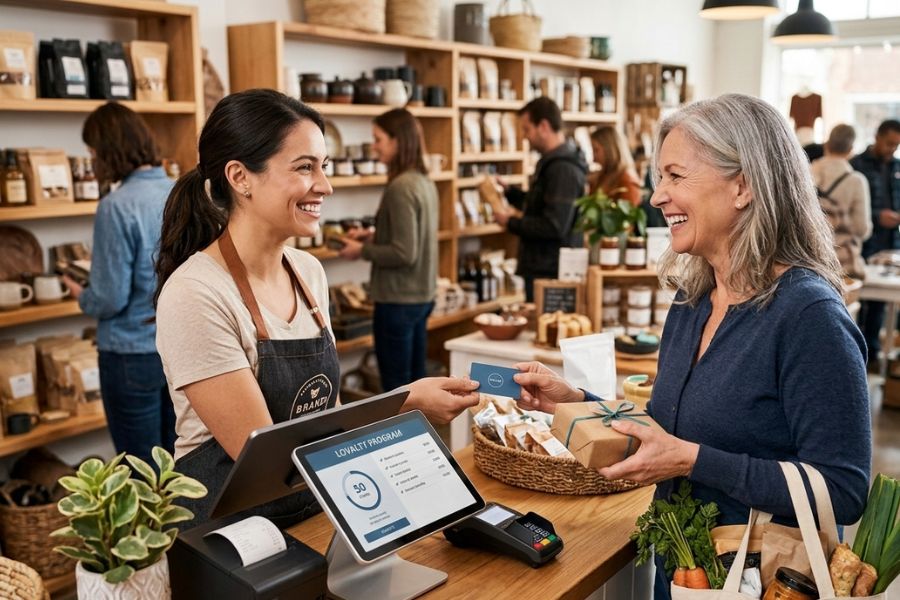
Consistency plays a central role in trust and retention. When loyalty programs are tied directly to the POS for a retail store, the same earning rules, point balances, and reward conditions apply across stores, online checkouts, and mobile interactions. Customers are not required to re-explain themselves, re-register, or question whether a reward earned in one place can be used in another.
This continuity shapes how customers perceive the brand over time. Earning points in-store and redeeming them online, or vice versa, feels predictable and fair, which removes friction from repeat purchases. As a result, loyalty participation stays active beyond short campaigns, supporting long-term engagement rather than one-time promotional spikes.
Read more: The Best POS Systems for Retail Stores in US for Omnichannel Selling
Converting sales data into customer insights
Beyond rewards, the data of POS system for retail shop reveals long-term customer value through frequency, recency, and spend trends. Retailers identify which customers grow over time, which lapse after promotions, and which respond to specific incentives.
These insights guide smarter decisions around segmentation, retention focus, and campaign timing. Sales data shifts from reporting past performance to shaping future loyalty strategies that support sustainable revenue rather than one-off transactions.
For example, the data of POS for retail store can identify customers who buy infrequently but spend more, often returning only during promotions. Retailers can replace broad discounts with targeted incentives such as early access or bonus points to encourage repeat visits.
At the same time, frequent shoppers with smaller baskets may respond better to bundles or tier-based rewards. This shifts sales data from simple reporting to guiding retention strategies that build long-term customer value.
Read more: The Future of Business POS Systems in US: Retail Trends in 2026
ConnectPOS – Driving Customer Lifetime Value Through Smart Retail POS
ConnectPOS supports retailers focused on long-term customer value rather than isolated transactions. Daily sales activity feeds directly into customer profiles, loyalty logic, and cross-channel visibility, allowing teams to understand how shoppers return, spend, and evolve over time.
Key Points
- Customer behavior captured at checkout: Each sale contributes to a growing customer profile that reflects visit frequency, average spend, and product preference. Over time, these records reveal how value accumulates beyond single purchases and which behaviors signal long-term engagement.
- Loyalty logic applied consistently across channels: Reward balances, earning rules, and redemption conditions remain the same in-store and online. This consistency removes uncertainty for customers and keeps loyalty participation active across different shopping contexts.
- Targeted incentives shaped by purchase history: Promotions align with what customers actually buy and when they return, replacing generic campaigns with incentives that feel relevant and timely without eroding margin.
- Linked online and in-store activity: Browsing behavior, wishlists, and digital orders connect to in-store purchases under one customer record. This connection clarifies how channels influence each other and supports coordinated retention actions.
- Clear insight into high-value and at-risk segments: Sales data highlights customers who increase spending over time, those who respond only to promotions, and those whose activity begins to slow. Teams can focus retention efforts where long-term value is most likely to grow.
- Ongoing measurement of loyalty impact: Customer value updates after every transaction through analysis and reports, allowing retailers to evaluate which loyalty actions support repeat behavior and which drive only short-term sales.
- Click-and-Collect Support: The platform manages Buy Online, Pick Up In-Store (BOPIS) workflows. This bridges the gap between digital browsing and physical interaction.
- Diverse Payment Options The interface accepts digital wallets, credit cards, and split payments. Quick checkout processes prevent long queues and abandoned carts.
FAQs
What role does a POS for retail store play in customer lifetime value?
A POS system records every purchase, visit, and spend pattern at the moment of sale. Over time, this data builds a clear picture of how customers return and grow in value, allowing retailers to focus on retention rather than isolated transactions.
How does a POS software for retail shop support loyalty beyond discounts?
Instead of relying on blanket promotions, POS data supports rewards tied to actual behavior such as frequency, basket size, or product preference. This keeps loyalty engagement active without pushing margins down through constant price cuts.
Why does linking in-store and online data matter for loyalty?
When POS system for retail shop connects physical and digital activity, customers earn and redeem rewards consistently across channels. This continuity builds trust and prevents loyalty fatigue caused by fragmented experiences.
Read more: Top 5 POS Systems for Retail Store in The US (List of 2026)
Conclusion
Loyalty does not come from isolated incentives or one-time campaigns. It develops through consistent recognition, accurate customer context, and rewards that align with real buying behavior across channels. POS system for retail shop that connects sales, customer identity, and loyalty logic allows retailers to move from transactional selling toward relationship-driven revenue that compounds over time.
Connect with the ConnectPOS team to see how your retail POS can support customer lifetime value through clarity, consistency, and data-led loyalty at scale. Contact us now!
►►► Optimal solution set for businesses: Shopify POS, Magento POS, BigCommerce POS, WooCommerce POS, NetSuite POS, E-Commerce POS