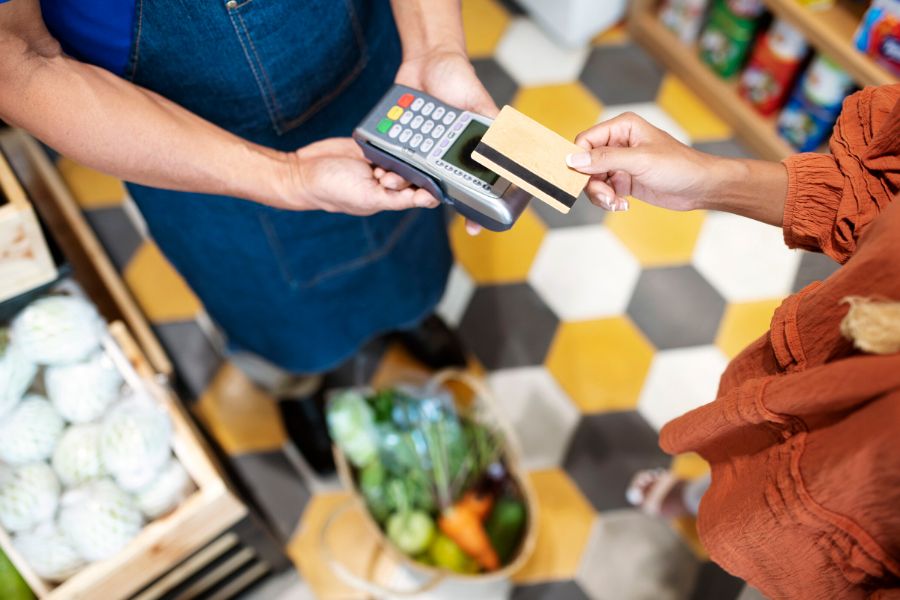
Many business owners use the terms merchant service and POS system as if they mean the same thing, but they serve different purposes in daily operations. A merchant service mainly helps businesses accept and process payments, while a POS system supports a wider range of functions such as sales transactions, inventory tracking, customer management, and reporting.
Understanding the difference is important when choosing the right tools for your business. If you only focus on payment processing, you may overlook the operational features needed to run your store efficiently.
In this article, we will explain the key differences between a merchant service and a POS system, and how each one contributes to a smoother retail operation.
What is a merchant service?
Merchant services are a suite of financial tools and technologies that enable businesses to accept various payment methods, including credit cards, debit cards, and digital wallets. These services handle the secure processing of transactions, both online and in-person, and provide essential hardware, software, and compliance services to manage cash flow effectively.
What is a POS system?
Meanwhile, POS (or point of sale) refers to the location where a consumer made a transaction, such as a cash register. Most contemporary point-of-sale systems can do more than simply ring up purchases and handle returns; they can also keep track of your inventory, provide insights into your company’s performance, and even assist you in launching and running an omnichannel shopping experience.
From these 2 definitions, a merchant service is a broader term than a POS system. You can understand POS as a type of merchant service. Why is this the case?
What can be considered a merchant service?
For the merchant service, you’ll need the following items to take credit card payments in-store and online:
- Credit card processing terminal: Accept and process credit cards
- Payment processor: Enable the terminals to work
- Merchant account: Your bank account to process transactions
- Payment gateway: Collect payments for your eCom store (because you can’t enter a credit card into a physical terminal when buying online).
- POS system: Accept card transactions and can track sales, provide detailed reports, and much more.
Now that you know POS can be considered a type of merchant service, you might be wondering what exactly a POS system can do. Is it similar to other merchant services?
The main difference between merchant services and POS systems
The easiest way to understand the difference is this:
- Merchant services focus on payment processing
- POS systems focus on sales operations and store management
A merchant service is usually one part of the payment ecosystem. A POS system is often the tool your team uses directly at checkout to ring up sales, manage orders, and access store data. In many businesses, the POS system connects to a merchant service so payments can be processed.
Merchant service vs POS system: key differences
1. Core purpose
The main purpose of a merchant service is to allow a business to accept and process payments securely. Its role is financial and transaction-focused.
The main purpose of a POS system is to support the selling process from checkout to recordkeeping. It helps staff complete sales and manage operational tasks around those sales.
2. Business functions
Merchant services usually cover:
- payment authorization
- payment processing
- fund settlement
- fraud prevention
- gateway or terminal support
POS systems usually cover:
- checkout and sales processing
- product lookup
- inventory tracking
- customer management
- receipts
- returns and exchanges
- reporting and analytics
3. Hardware and software role
Merchant services may involve payment terminals, card readers, and online payment gateways, but their primary role is still centered on payment acceptance.
A POS system includes both hardware and software for running transactions in-store, such as barcode scanners, receipt printers, touchscreens, and retail management dashboards.
4. Scope of business management
Merchant services do not usually manage wider retail operations like stock levels or customer purchase history.
POS systems are designed to support broader operational visibility. They can track what was sold, when it was sold, who bought it, and how inventory changed after each transaction.
5. Use case in daily operations
A merchant service works mostly in the background to ensure money moves correctly from the customer to the business.
A POS system is the front-line tool staff use every day to handle store activity, serve customers, and manage transaction-related workflows. This distinction is why businesses often need both, not just one.
Do you need both a merchant service and a POS system?
In many cases, yes. Most retail businesses need a way to accept payments and a system to manage sales operations. That means they often use a POS system connected to merchant services.
For example, a small shop may use a POS interface to scan products, apply discounts, and print receipts, while the merchant service handles the card transaction itself. The customer sees one smooth checkout experience, but behind the scenes, these are different functions working together.
Can a POS system include merchant services?
Yes. Many modern POS providers bundle payment processing into their platform, which makes the distinction less visible to the end user. Even so, the functions remain different. The payment side still handles authorization and settlement, while the POS side manages store operations, transaction records, and business workflows.
This is why some business owners think they are the same thing. In practice, they are connected, but not identical.
Which one is more important for your business?
That depends on what your business needs.
If your main goal is simply to accept card or digital payments, merchant services are essential.
If your business needs better control over inventory, customer data, reporting, and daily retail operations, then a POS system becomes just as important.
For most retailers, restaurants, and omnichannel sellers, the better question is not which one is more important, but whether the two tools work well together. A disconnected setup may create payment friction, reporting gaps, or extra manual work.
What can POS do?
Nowadays, businesses often prefer a cloud-based point of sale system, due to its affordable price and ease of use. In this way, you can save data on a distant server (known as “the cloud”). Users can easily access and control the back office of their POS system via the Internet.
Some of the most basic and frequently-used features of POS are:
- Inventory management
- Employee management
- Report and analytics
- Third-party integrations (i.e. reward points system)
Some POS also include payment processing, which is called integrated payment. When a consumer enters their card, the amount they’re paying is automatically entered in your POS, thanks to the compatibility between your payment processor and POS. Later on, you may utilize this information to analyze your sales data. Without a cloud-based POS, you might have to manually enter the data into your system.
Wrapping up
A merchant service and a POS system are 2 different terms, however, they have joint functions in payment processing. It is important to point out that POS can become an all-in-one solution for businesses, which can be integrated with other merchant services.
Being a leading cloud-based POS provider, ConnectPOS takes pride in various tools for merchants, such as the different types of payments and omnichannel features. Don’t hesitate to contact us if you have any questions.