Luxury loyalty grows through recognition and continuity rather than transactions alone. In this setting, POS no longer sits at the end of the experience. It shapes how relationships are remembered and carried across time, locations, and channels. Chanel illustrates this shift clearly. Its POS supports client memory and service continuity, so that each interaction feels informed without becoming procedural. Sales associates remain central, while technology holds context quietly in the background.
This article explores how Chanel POS turns transactions into personalized clienteling success, examining personalization in luxury retail and the move from transactional systems to relationship platforms. The perspective reflects guidance from ConnectPOS, informed by work with retailers scaling high-touch service across modern store networks.
Highlights:
- Chanel uses POS to support client recognition and context, keeping personalization human, discreet, and relationship-led rather than promotional.
- Client history moves with the customer across boutiques, online touchpoints, and private appointments, allowing conversations to resume naturally.
- Associates rely on POS for preparation and follow-up, turning each transaction into part of an ongoing relationship that drives repeat luxury spending.
Personalization in the Luxury Retail World
In luxury retail, personalization is not a feature, it is the core expression of the brand promise. Unlike mass retail, where personalization often means automated recommendations or discounts, luxury personalization is rooted in human relationships, memory, and discretion.
Luxury brands personalize through people first, technology second. Sales associates are expected to remember clients’ preferences, sizes, past purchases, and even life milestones. Technology exists only to support that memory, never to replace the human connection or interrupt the in-store experience.
True luxury personalization has several defining traits:
- Recognition, not recommendation: Knowing who the client is matters more than suggesting what to buy
- Continuity across touchpoints: Conversations continue seamlessly across stores, channels, and time
- Contextual relevance: Personalization adapts to mood, occasion, and relationship stage
- Discretion and trust: Data is used quietly, respectfully, and invisibly
This is why POS systems in luxury evolve into clienteling platforms. They centralize client history and preferences so associates can deliver consistent, personal service without relying on promotions or algorithms.
In the luxury world, personalization is not about selling more items, it is about deepening the relationship, strengthening loyalty, and ensuring every interaction feels intentional, remembered, and rare.
Read more: Reasons to Upgrading POS System for Luxury Retail
Chanel POS Philosophy: From Transaction Tool to Clienteling Platform
Chanel views POS as more than a system for closing sales. It requires a shift from recording transactions to sustaining relationships, reshaping how technology supports the boutique experience. The sale sits at the end of the interaction, not at its center.
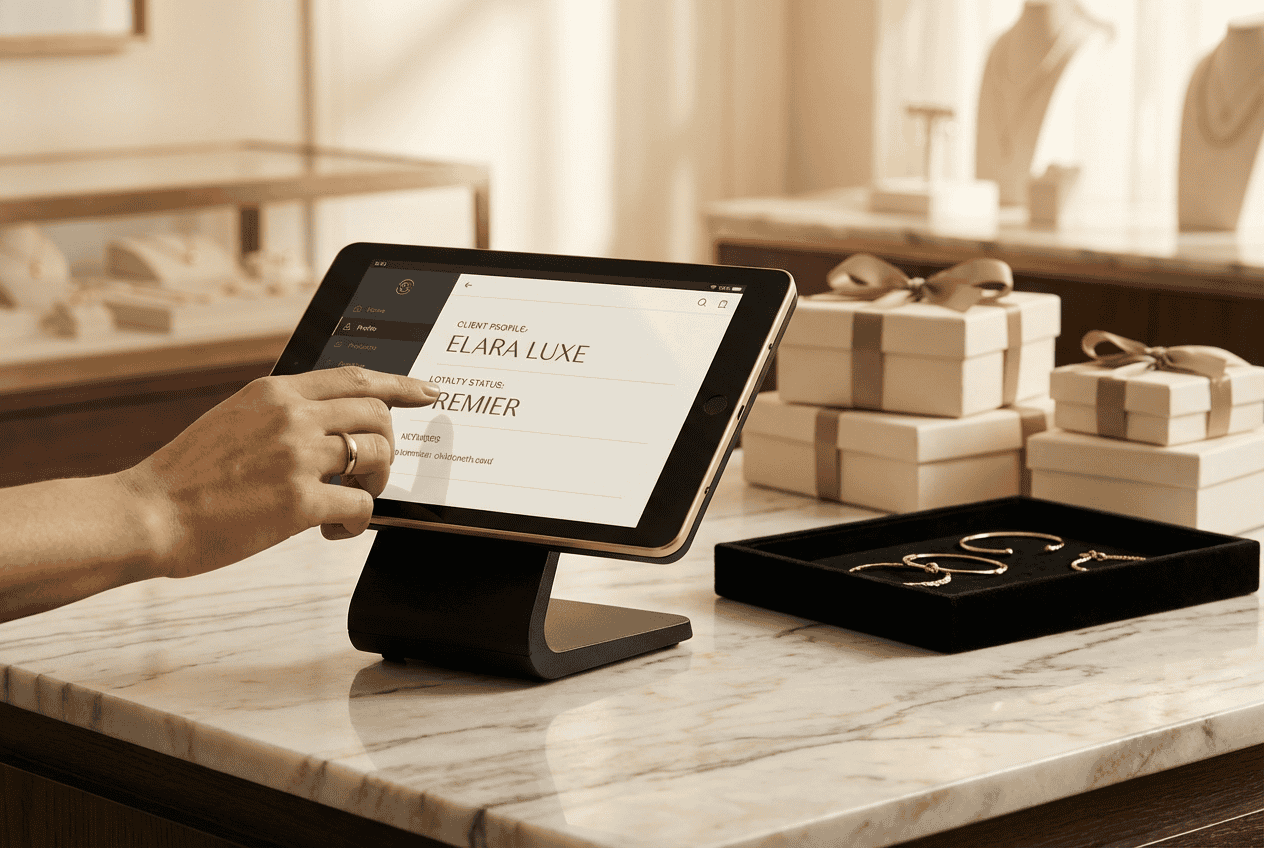
Within Chanel boutiques, POS supports client recognition and continuity. Sales associates access purchase history, preferences, and prior interactions to maintain context across visits and locations. This knowledge guides conversation and service, allowing interactions to feel familiar rather than procedural. Technology remains discreet, preserving the atmosphere expected in a luxury setting.
This philosophy reflects a broader belief inside Chanel: long-term value grows from trust and memory. POS functions as a clienteling platform that supports human judgment and personal connection, reinforcing luxury retail as a relationship-driven business rather than a transaction-driven one.
The Way Chanel POS Transforms Transactions into Personalized Clienteling Success
At Chanel, POS sits behind the client experience. The system supports personalization at scale by preserving relationship context across boutiques, channels, and time, while keeping the interaction led by sales associates. Transactions become a record of an ongoing relationship, not the focus of the encounter.
The following elements illustrate how Chanel POS enables this shift, turning everyday sales activity into sustained, personalized clienteling across a global retail network.
Real-time access to purchase history and preferences
Chanel POS gives sales associates immediate visibility into what a client has bought before, what categories they prefer, and details such as sizing and past service notes. Research in luxury retail shows that brands with strong client engagement retain a large share of revenue from repeat business, with top clients driving most of the sales. For example, the top 2 % of customers in luxury goods can account for around 45 % of total purchases, highlighting how valuable repeat relationships are.
In practice, when a client walks into a Chanel boutique after shopping in another city, the associate can look up prior purchases and preferences. Thus, they can continue the interactions exactly where they left off rather than starting over.
This contextual awareness makes the conversation feel intentional and considerate, reflecting deep familiarity without burdening the client with repeated questions.
Omnichannel data linking in-store, online, and private appointments
Luxury clients often engage with a brand across different settings. EY’s Luxury Client Index 2025 reports that most clients still buy in physical stores but many combine in-store visits with online browsing or research, with about one-third using both channels for the same purchase journey.
Chanel POS that links these channels into a unified record means that preferences expressed online or during private consultations inform the boutique interaction that follows.
For example, a client might view a handbag collection online, book a private appointment to see select pieces, and then complete the purchase in a store. The Chanel POS captures this progression so that the associate can speak knowledgeably about what the client has explored elsewhere and tailor the in-person experience to those interests. This continuity respects how luxury clients shop and supports a fluid journey across touchpoints.
Empowering sales associates with actionable client insights
Research into luxury consumer behavior shows that a positive customer experience strongly influences repeat purchases, with one study finding that 87 % of luxury shoppers would come back after a positive service encounter and 39 % would make multiple purchases.
Chanel POS provides context rather than instructions. Associates interpret client information based on relationship depth, timing, and mood. This model aligns with luxury retail data showing that client satisfaction correlates more strongly with associate knowledge and confidence than with speed or automation.
In boutiques, associates often review client context before engagement, then step away from the screen during conversation. POS supports preparation and follow-up, not real-time prompting. Scale emerges through shared access to relationship history across the network, while personalization remains anchored in human judgment.
Chanel uses this balance to maintain consistent service standards globally without diluting the individuality expected in luxury retail.
ConnectPOS – Enabling Luxury-Grade Clienteling for Modern Retail Brands
ConnectPOS is built to support clienteling models shaped by luxury retail principles, where value comes from continuity, recognition, and trust rather than transaction speed. The platform acts as relationship infrastructure, allowing brands to scale personalized service across stores and channels while keeping interactions led by people, not screens or scripts.
- 360° Client Profiles & Personalization: Maintain detailed client records that include purchase history, style preferences, measurements, and gifting notes. Sales associates use this shared context to prepare interactions in advance, respond with relevance, and support long-term relationships through CRM-enabled POS and a client-first CX framework.
- Omnichannel Continuity: Client activity across online stores, boutiques, showrooms, and warehouses connects in real time. Browsing online, reserving in-store, and home delivery follow a single relationship path rather than separate transactions, preserving continuity across touchpoints.
- Mobile POS & Clienteling Tools: Associates operate directly from tablets or smartphones to check availability, review client context, and complete transactions anywhere on the floor. This mobility supports discreet, high-touch service without pulling the interaction toward a fixed counter.
- Checkout Experience: Checkout completes the interaction rather than interrupting it. Support for varied payment methods, loyalty identification, and digital receipts keeps the process brief and unobtrusive, reinforcing a premium service rhythm.
- Unified Loyalty & VIP Programs: Loyalty points, gift cards, and membership tiers operate consistently across channels with loyalty program tools from ConnectPOS. Client recognition remains intact regardless of where engagement occurs, supporting emotional connection rather than promotional dependency.
- Multi-Currency & Multi-Language Capability: Transactions, receipts, and client-facing communication adapt to language and currency preferences, supporting international clientele across global store networks.
- Real-Time Inventory & Endless Aisle: Associates can locate limited or unavailable items across stores and warehouses during the interaction. Orders route directly for delivery, allowing the relationship to continue even when stock is not physically present.
- Appointment & Concierge Management: Private shopping sessions, curated selections, and concierge-style services are planned and tracked within the POS environment, allowing preparation and follow-up to remain structured without becoming visible to the client.
- Analytics & Client Intelligence: Sales patterns, product performance, and client lifetime value are visible at both store and network level. These insights inform merchandising and outreach decisions while supporting associate preparation rather than automated selling.
- Security & Data Governance: Payment processing and client data handling align with PCI-DSS and GDPR standards. Trust is reinforced through controlled access, secure gateways, and monitored transaction activity.
- Platform Integration & Extensibility: Integration with commerce platforms such as Magento, Shopify, BigCommerce, and Salesforce supports complex retail environments. APIs allow alignment with regional systems and enterprise workflows.
- Offline Mode Reliability: Sales continue during connectivity interruptions, with transactions stored locally and synchronized once service returns. Client experience remains uninterrupted.
Read more: Top 5 Offline Mode in a POS System in 2026
FAQs
What does luxury loyalty mean in the context of Chanel POS?
Luxury loyalty centers on recognition and continuity rather than points or discounts. Chanel POS supports loyalty by preserving client history and preferences across visits, allowing each interaction to feel familiar and considered. Loyalty develops through memory and trust built over time.
How does Chanel POS support repeat client relationships?
The system records purchase history, sizing, product interests, and service notes. Sales associates use this information to continue conversations instead of restarting them. Returning clients are acknowledged through context rather than formal identification or scripted questions.
What can other luxury brands learn from the Chanel POS approach?
Luxury loyalty scales through shared relationship memory, not scripts. POS should support people, preserve context, and allow service to adapt naturally across stores and time.
Conclusion
Chanel POS approach shows that luxury loyalty develops through shared memory rather than standardized programs. Transactions record relationships already formed, while clienteling depends on continuity, judgment, and discretion. For retail brands, this points to a clear path forward. POS must support preparation and follow-up while staying out of focus during client interaction. Scale comes from connected client knowledge, not scripted behavior.
ConnectPOS supports brands ready to adopt this model. For retailers seeking to build luxury-grade clienteling across growing networks, ConnectPOS provides the foundation to carry relationships forward with consistency and care. Contact us now to know how your POS strategy can support lasting client relationships.
►►► Optimal solution set for businesses: Shopify POS, Magento POS, BigCommerce POS, WooCommerce POS, NetSuite POS, E-Commerce POS